XR in Automotive: How Automakers Are Using XR, Digital Twins, and AI
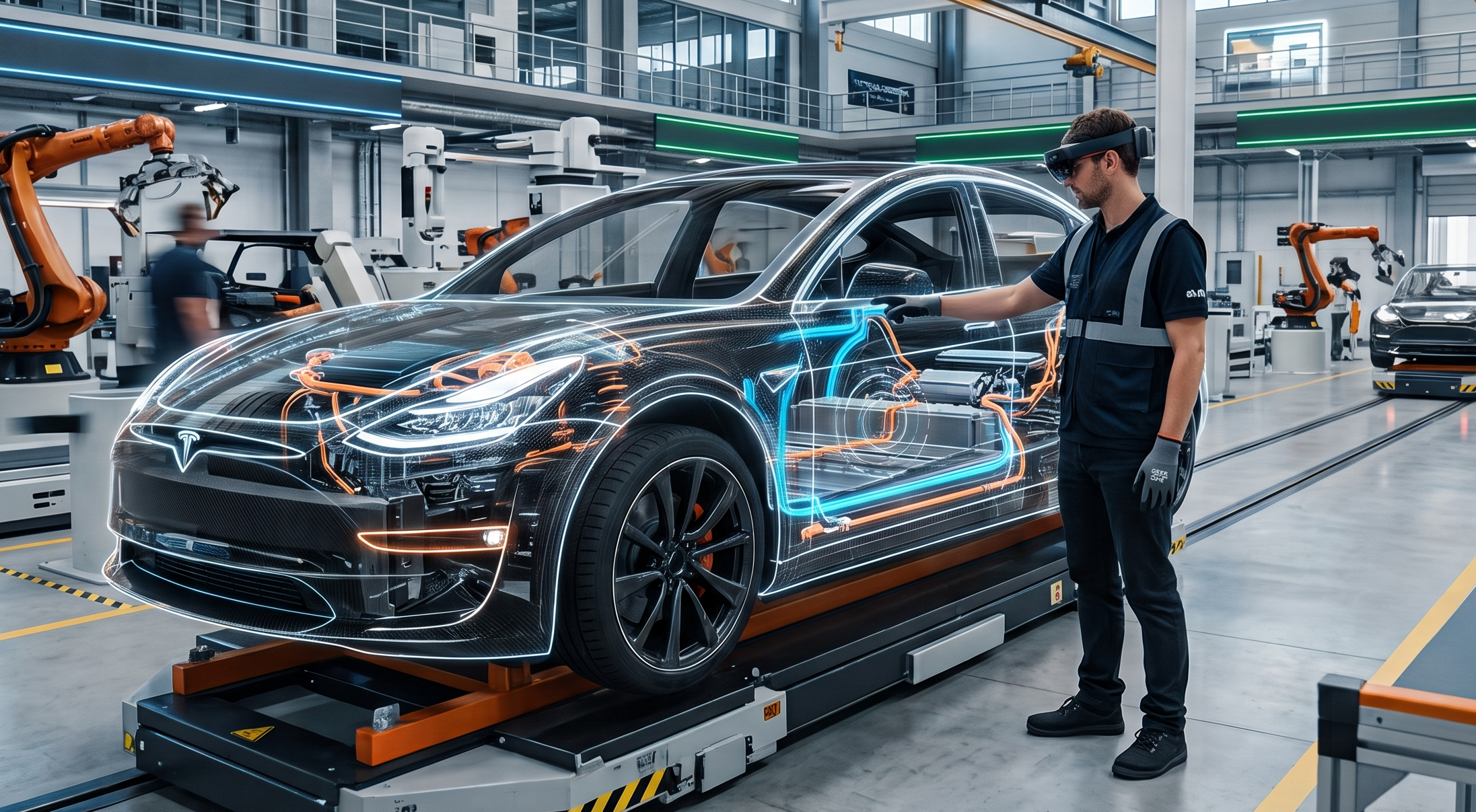
Automotive companies have been on the cutting edge of emerging technology adoption for a decade now. As an industry, automotive is a perfect example of how technologies like extended reality, digital twins, and artificial intelligence can transform not just individual tasks but an entire sector.
The pressure to innovate in the auto industry is due to a number of factors, including a severe shortage of skilled workers. It’s estimated that the U.S. needs more than 100,000 new automotive technicians each year to meet demand and replace workers leaving the field, far more than the number of people currently preparing for careers in the industry.
At the same time, vehicles themselves have changed. Modern cars are more electronic than physical, packed with software, sensors, battery systems, advanced driver assistance features, infotainment, connectivity, diagnostics and, increasingly, AI-enabled capabilities. Cars today are complex technology platforms. It makes sense that the tools used to design, build, inspect, sell, and service them would become more digital, too.
Here are some recent examples of how automakers are using XR, digital twins, and AI across the vehicle lifecycle.
Ford
Ford began using VR in 2015 along with infrared cameras and motion capture software to identify unergonomic assembly procedures. After piloting HoloLens in 2016 to reduce the number of clay models needed to finetune designs, Ford made XR a regular part of the vehicle design process.
Since then, Ford has used mixed reality to improve collaboration between disciplines, tested tools for working together in the same virtual design space, trained technicians to service vehicles in VR, and provided AR-enhanced remote support to dealerships. The company has used AR for “see-what-I-see” vehicle repairs and to aid operators on the factory floor, reducing errors and helping workers manage increasingly complex vehicle systems. Ford has also tried a few mobile AR marketing campaigns.
In 2025, Ford CEO Jim Farley called AI-powered augmented reality a “game changer” for technicians working on Ford trucks, specifically pointing to the complexity of repairing a Super Duty. Ford has also used HoloLens for training at its Dearborn Engine Plant, combining immersive guidance with written instructions, shadowing, and on-screen 3D models to improve quality.
BMW
BMW began testing wearable AR early, including the original Google Glass for quality control in 2014. Since then, the company has embraced extended reality across product development, production, training, marketing, and driver assistance.
BMW has used VR for workstation planning, to simulate new production areas and processes before implementing them; as well as AR for engine assembly training, process guidance, parts inspection, and an in-car system that overlays lane recommendations, parking rates, and other info over live video. On the customer side, the luxury brand has released several immersive experiences, including view-in-your-driveway, virtual test drive, and virtual showroom experiences.
BMW also provides one of the clearest examples of automotive digital twin adoption. The company is a committed user of NVIDIA Omniverse and virtual factory systems to simulate and optimize production processes before physical implementation. BMW’s Virtual Factory can model layouts, simulate manual tasks, and optimize robotics and logistics systems, with the company citing planning cost reductions of up to 30%.
The company has also partnered with Meta to explore in-car XR experiences and used Meta Quest 3 for training in high-voltage battery work, which involved a digital twin of BMW’s fifth-generation EV battery to help technicians practice safely before working on real assets.
Porsche
Porsche’s “Tech Live Look” program remains one of the strongest examples of AR-enabled remote support in automotive service. Introduced around 2017, the system connects dealership technicians with remote experts through AR glasses. Porsche reported that the program cut service resolution times by up to 40%.
The company has also used immersive technology for product visualization and marketing, including a mobile AR app that allowed users to see “under the skin” of the all-electric Taycan and a photorealistic digital twin demo involving NVIDIA, Autodesk, Lenovo, and Varjo.
More recently, Porsche used HoloLens 2 for remote support and training of dealer technicians, Meta Quest 3 for immersive product demonstrations and technical briefings, and Apple Vision Pro during the reveal of the new 911 Turbo S. In that demonstration, colocated Vision Pro headsets were employed to walk viewers through the vehicle’s drivetrain at different scales.
Toyota
Toyota has used VR to evaluate vehicle ergonomics and validate designs faster, and HoloLens 2 for immersive training and on-the-job work instructions. Technicians used mixed reality – especially during the pandemic – to view parts diagrams, follow inspection workflows, learn new car features, and connect with remote experts.
Toyota’s XR work also extends into robotics and safety. In 2023, Toyota partnered with Ready Robotics to simulate and program industrial robots for aluminum hot forging production lines using NVIDIA Omniverse. Instead of programming around hot metal parts, teams could test robotic processes in a realistic digital environment and then transfer proven programs to live production work cells.
More recently, IndustryWeek reported on Toyota’s use of VR to train maintenance team members in basic safety practices at Toyota Motor Manufacturing Kentucky, while in Texas the automaker uses VR to train welders without wasting steel or burning electrodes.
Mercedes-Benz
Mercedes-Benz has applied XR across sales, service, production, and future vehicle experiences since 2018. The German brand used HoloLens to demonstrate potential applications internally, launched an AR sales configuration tool, introduced in-car AR navigation, and created an AR owner’s manual.
In service and maintenance, Mercedes has used mixed reality to connect diagnostic technicians at dealerships with remote specialists, explored AR-style remote support in Formula 1, and deployed RealWear HMT-1 headsets across service centers in Turkey.
On the production side, Mercedes-Benz has worked with NVIDIA Omniverse to design, plan, and optimize factories, including preparation for manufacturing new EV platforms. The company views AI-powered digital twins as part of a broader effort to digitize the automotive lifecycle.
Mercedes has also applied digital twins to energy planning. As part of its transition toward 100% renewables by 2039, the company built an energy-focused digital twin to simulate a physical energy system, test planning scenarios, and optimize for energy efficiency, cost savings, and emissions reductions.
Rivian
As an EV maker, Rivian uses VR to support more efficient and sustainable design and production processes. With teams distributed across California, Arizona, Illinois, Michigan, and other locations, the company relies on VR to improve collaboration while reducing the need for frequent travel.
VR has enabled Rivian to move beyond traditional vehicle design workflows, which rely heavily on physical mocks such as clay and wood models. With life-size 3D models in virtual environments, teams can review designs, make real-time changes, and complete more iterations than would be practical with physical prototypes alone.
Rivian began its VR initiative in 2016. Today, employees use Autodesk VRED software on Varjo headsets for detailed design work, while the company is also evaluating NVIDIA RTX PRO 6000 Blackwell Workstation Edition GPUs to enhance advanced XR visualization and collaboration. According to NVIDIA, the new hardware delivered rendering speeds up to 80% faster during Rivian’s design reviews, allowing teams to work with large, complex vehicle models without sacrificing detail or performance.
Stellantis
Stellantis has used virtual reality to reduce costs and save time in vehicle manufacturing. At its CTC complex in Auburn Hills, Michigan, the company operates a VR lab large enough for teams to review an entire assembly-line station in a virtual environment.
In a 2025 demonstration, users wore VR headsets, battery packs, and handheld controllers to recreate assembly tasks from the Jeep Wrangler production line. This allowed teams to assess how parts are handled, how easily components can be reached, and how workstation designs could be improved before any physical changes were made.
According to Stellantis, the VR lab helps ergonomics teams optimize platform heights, define ideal reach zones, and refine parts-handling processes. It also supports the design of new factories and improvements to existing production lines, reducing the need for plant shutdowns, physical trials, and costly prototypes.
Volkswagen
Volkswagen has been exploring immersive technology in design, service, training, and production for more than a decade. The automaker has worked with researchers on VR and haptics for vehicle design, adopted AR-based remote support to speed up service and repair opeartions, and used AR to help design production lines for electric vehicles.
In 2021, Volkswagen Commercial Vehicles began testing SenseGlove Nova force feedback gloves for realistic assembly line training in VR. The pilot concluded the following year with positive results.
More recently, Volkswagen Group entered a long-term partnership with Dassault Systèmes to use the cloud-based 3DExperience platform as a core engineering and manufacturing environment. Engineers, designers, and other professionals across Volkswagen, Audi, and Porsche will use virtual twins to streamline vehicle development, simulate and test designs, and manage the growing complexity of electric cars, autonomous systems, digitization, and sustainability initiatives.
General Motors
General Motors has deeply integrated VR into its vehicle development process. Today, every GM vehicle undergoes virtual testing and the company’s Virtual Reality Assembly Center (VRAC) in Warren, Michigan is among the largest VR facilities of its kind in the world.
Teams use immersive environments to design vehicles, conduct virtual reviews, and identify manufacturing issues before physical prototypes are built. Workers across GM can log into virtual plants and collaborate on vehicle programs years before production begins, resulting in greater precision, faster development times, and significant cost savings.
Last year, the American auto giant announced a partnership with Nvidia to use Omniverse with Cosmos to create digital twins of assembly lines for virtual testing and production simulation. GM is also incorporating AI to apply historical insights to virtual assembly evaluations.
Conclusion
Automotive XR has moved well beyond isolated demos and marketing experiments, becoming a standard tool for designing, building, selling, servicing, and even driving vehicles.
As vehicles become more software-defined and therefore more challenging to develop and maintain, the tools surrounding them are evolving as well. Combined with digital twins and AI, XR is part of the automotive industry’s response to rising complexity.
XR enables teams to visualize intricate systems, collaborate across locations, test physical processes before implementation, guide technicians through complex repairs, and transfer knowledge more effectively. In many cases, it helps companies identify and solve problems long before they reach the factory floor or customer.