Digital Twin It, Then Execute: The New Strategy for Enterprise Planning
Digital twins are providing measurable value as powerful tools for enterprise planning. From processes to physical spaces, enterprises across industries are turning first to digital twins to test ideas before acting in the real world. In this post, learn how real companies are using digital twins to plan electricity networks, marketing campaigns, assembly lines, and drive systems. The results include reduced costs, shorter timelines, lower risk, fewer errors, improved customer satisfaction, and more.
National Grid: From Reactive to Predictive Planning with Digital Twins (ENERGY)
The utility provider worked with Atos to develop Triton, a digital twin platform for streamlining the planning of electricity networks. Triton leverages advanced visualization and automated data integration to accelerate infrastructure (grid) decisions. To facilitate stress testing and provide long-term visibility, the platform consolidates and processes thousands of datasets from diverse sources such as legacy systems (internal) and Distribution Network Operators (DNOs) and transmission owners (external). Engineers can run rapid simulations of complex network scenarios – modeling future demand and supply at specific grid points and transmission substations – to make reinforcement decisions 70% faster (compared to static mapping) and direct investment where it’s needed most.
In addition to identifying where new infrastructure is required and evaluating the impact of embedded generation on local/regional network capacity, Triton aids in assessing future high-load customer connections like data centers and renewable installations. Thus, digital twin technology is essential to National Grid’s ability to deliver a resilient, future-ready electricity network that can meet the energy demands of decarbonization.
Digital Twins as a Creative Medium at Nestlé (RETAIL)
Nestlé collaborated with Nvidia, Microsoft, and Accenture to apply digital twins and AI to its global marketing efforts. The company already has (as of June 2025) a library of around 4,000 digital product twins, with plans to convert a total of 10,000 physical products into digital twins in the next two years.
More than 250 marketing experts now use the in-house, AI-powered digital twin service to generate and adjust packaging designs and other creative content for seasonal campaigns, ecommerce, and a wide variety of digital media channels.
This cuts down on the need for reshoots and accelerates content production cycles, making it faster, easier and more cost effective to, say, localize packaging designs or adapt campaigns to multiple social media platforms. Nestlé is able to do more with the talent it already has while keeping its brands up to date in the always-evolving digital sphere.
GM Deepens its Commitment to AI-driven Manufacturing (AUTOMOTIVE)
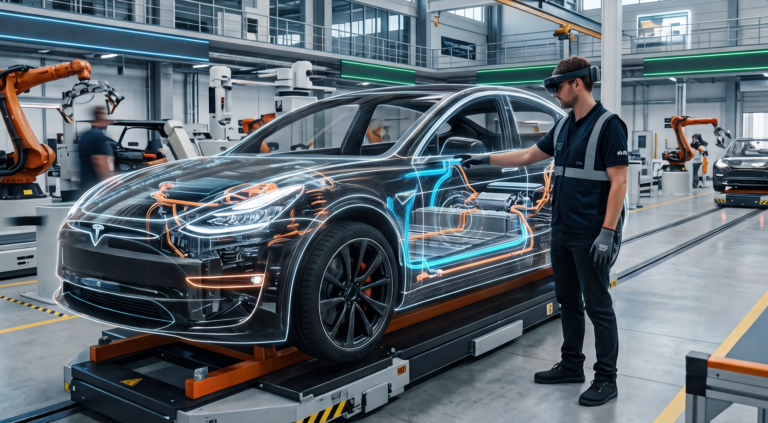
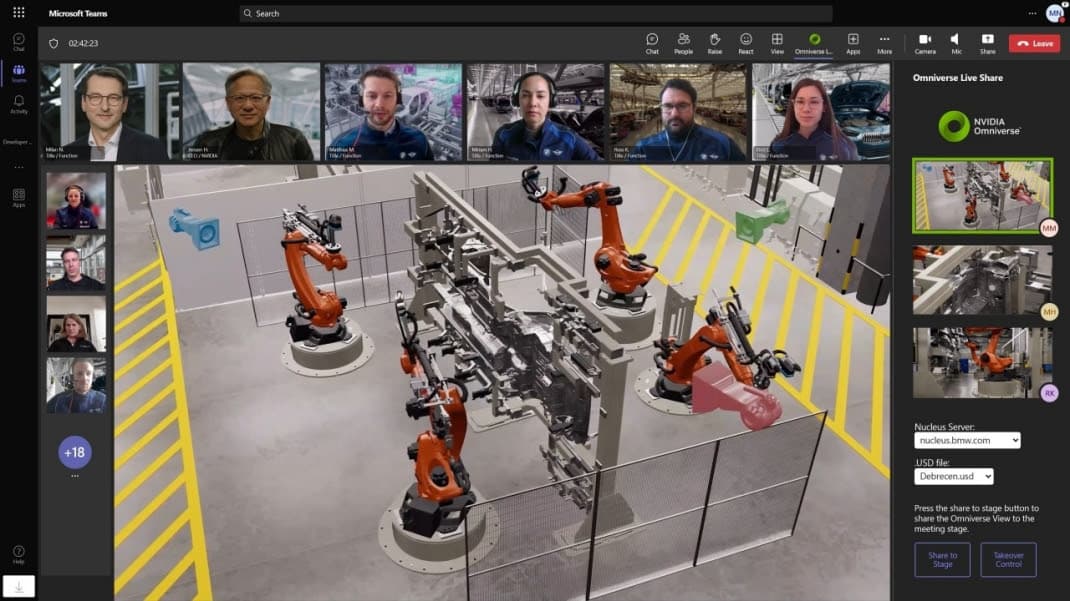
General Motors has partnered with Nvidia to harness the power of AI to enhance automation, cut costs, and improve efficiency across its factories. More specifically, GM is pairing Nvidia Omniverse with Nvidia Cosmos to create digital twins of its assembly lines for virtual testing.
The virtual replicas allow engineers to simulate and optimize production processes before physical implementation and without disrupting existing vehicle production. The partnership also expands GM’s use of AI to train factory robots for tasks like material handling, transport, and precision welding.
The auto giant frames AI and robotics as workforce support rather than replacement, emphasizing improvements to worker safety and reductions in physical labor. The effort also aligns with GM’s larger goal of converting roughly half of its assembly operations to electric vehicles by 2030.
NORD Extends Virtual Testing to Customers (MANUFACTURING)
NORD Drivesystems develops and produces a wide range of drives for more than 100 industries. The company uses data-based simulations to develop its components and drive solutions, and recently launched myNORD to extend the capability to customers. Users can configure drive systems for their requirements – they can select components and features – then simulate how they perform under real work conditions to verify concepts early in the design phase.
It’s called virtual commissioning and it significantly reduces project time, shrinking the overall process from configuration to actual commissioning from several months to just a few weeks. Only once a customer has made necessary adjustments and extensively tested it in the virtual environment does NORD manufacture and deliver the drive system.
While the initial focus is on drive systems and components important to automating production processes, NORD expects to expand digital twin simulation capabilities to other product areas over time.
Digital Twins as Decision Systems
Beyond planning, digital twins are fundamentally changing how organizations make decisions. Since their early use at NASA to study spacecraft, digital twins have expanded dramatically in scope and functionality. We’ve covered real-world applications across industries, from automotive and oil and gas to banking and retail. As the technology continues to advance, its impact will only grow as will enterprise reliance on digital twins to drive major decisions.
Image Source: Nvidia