Designing Augmented Reality at Walmart: A Conversation with Yuanhao Zhu
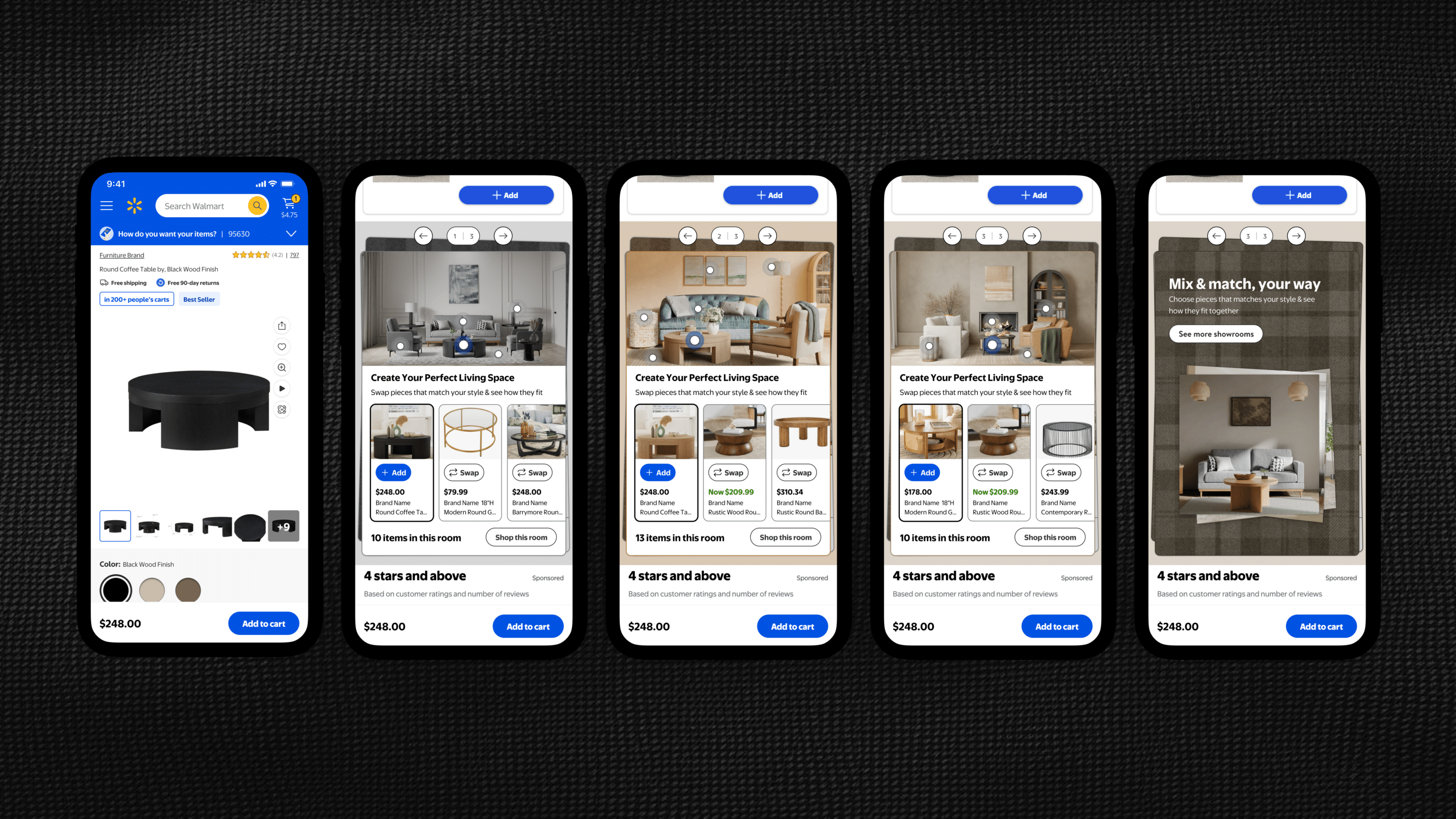
We had the opportunity to speak with Yuanhao Zhu, a UX designer crafting the future of digital retail through immersive technology, AI, storytelling, and human-centered design. At Walmart, her work spans AR shopping, inspiration-led discovery, dynamic showroom experiences, and Sparky, Walmart’s AI shopping assistant; helping make product discovery feel more intuitive, personal, and confidence-building for customers.
Yuanhao’s work has earned 4 international design awards, including 2 iF Design Awards and 2 MUSE Design Awards. She’s passionate about transforming bold ideas into simple, useful experiences that create real customer impact. Join us behind the scenes of Walmart’s AR experiences and learn more about Walmart’s XR projects over the years.
Emily: What is your background? How did you “get into” UX design and when did you join Walmart?
Yuanhao: My path into UX design was not a traditional one. I started as a pre-dental student majoring in Human Biology, and during that time I volunteered in a dental clinic. What really changed my direction was seeing how difficult the software was for documenting patient history. It was unintuitive, slowed people down, and added friction in an already busy environment. That experience made me realize how much product design affects people’s daily lives and how meaningful it would be to create tools that truly help users.
That realization led me to pivot into design. I added HCI design as my second major and later pursued a master’s degree in Information Science focused on UX design.
Emily: What is your role at Walmart? How did you end up designing immersive commerce experiences?
Yuanhao: I joined Walmart in 2022 as a UX Designer directly on the Emerging Tech design team, and since then I’ve been focused on designing immersive, customer-centered shopping experiences that make retail more intuitive, engaging, and useful.
Emily: What is Walmart’s Retina platform? How do various teams use it within Walmart?
Yuanhao: At a high level, Retina is Walmart’s 3D asset platform. Publicly, Walmart has described it as a platform that uses AI, GenAI, and automation to create tens of thousands of 3D assets and support immersive commerce APIs. Walmart has also said Retina powers 10 AR experiences across Walmart U.S. and Sam’s Club, and that it has helped drive higher adoption, lower return rates, and improved conversion.
From my perspective, Retina is important because it provides the foundation for building immersive shopping experiences at scale. It allows teams across design, product, engineering, and commerce to work from a common platform for 3D visualization and immersive interaction. Instead of treating each experience as a one-off experiment, it helps make immersive retail more repeatable, scalable, and integrated into the broader Walmart ecosystem. This is especially important as Walmart expands into virtual environments, Unity-based experiences, and more advanced 3D shopping flows.
Emily: Which AR shopping tools have you worked on, and what differentiates each from similar tools by competitors?
Yuanhao: I’ve worked on several immersive and AR-driven shopping experiences, including Beauty Virtual Try-On, Paint Virtual Try-On, View in Your Home, View in 3D, Shop the Background, and Dynamic Showroom. I was also the lead designer on multiple 0-to-1 initiatives in this space.
Each experience solves a different customer problem. Beauty Virtual Try-On helps customers see cosmetics and beauty looks in a more realistic, real-time way, while View in Your Home helps customers place furniture, décor, and certain large items like TVs into their own space before purchasing. Walmart has publicly positioned these types of AR tools as ways to help customers better visualize products, make more informed decisions, and reduce uncertainty when shopping online.
What differentiates Walmart’s approach, in my view, is that these tools are not just novelty features. They are tied to real shopping behavior, real assortment, and real customer problems across categories like fashion, beauty, and home. Walmart has also publicly shared that Retina-powered AR experiences have contributed to increased adoption, lower return rates, and improved conversion, which shows that immersive retail can be both creatively exciting and operationally meaningful.

Emily: What are important design factors for immersive shopping experiences?
Yuanhao: Accessibility is a core design factor for immersive shopping. The experience needs to be usable for people with different abilities and preferences, which means clear visuals, strong contrast, readable text, and alternatives to purely visual or motion-based interactions. Good immersive design should feel exciting, but it should also be inclusive, understandable, and usable for everyone.
Another important factor is preserving immersion. In an AR experience, I would try to maximize the viewport and keep the interface as light as possible, with fewer icons and fewer distractions, so the product can stay at the center of attention.
Emily: Can you describe the testing process?
Yuanhao: We use a mix of qualitative and quantitative testing methods depending on the stage of the project. Early on, we usually start with questionnaires, concept testing, and user research interviews to understand user needs, validate assumptions, and see whether the idea makes sense before we invest too much in execution. Once we have a stronger design, we move into A/B testing to compare variations and see what performs better with real users. Before launch, we also run a bug bash to catch usability issues and technical problems so the experience is as smooth and reliable as possible.
Emily: How is Walmart taking a unique approach to immersive retail?
Yuanhao: I think Walmart’s unique approach is that immersive retail is being treated as a practical shopping tool, not just a visual gimmick. It is connecting immersive experiences with real shopping behavior and content creation rather than treating AR as a standalone feature.
For example, in our ‘View in your home’ experience, Walmart takes a very practical approach compared to other competitors. The item is placed into your virtual space in a way that is true to size, so customers can judge scale and fit much more accurately. I personally tried a standing desk before buying it, and when it arrived, it matched exactly what I saw in AR. After that, I used it for a TV, couch, and TV stand as well, and it really helped me make decisions with more confidence. That is what makes the experience valuable: it’s not just immersive, it is useful and trustworthy.
Emily: What is Sparky?
Yuanhao: Sparky is Walmart’s AI-powered shopping assistant. It is designed to be the customer’s first stop for an easier, more enjoyable shopping experience by using Walmart’s product knowledge, customer context, and AI capabilities to help people make confident choices.
What makes Sparky unique is that it is not positioned as a person. It is an assistant: happy, helpful, and thoughtful. It knows Walmart’s products, learns what customers like, simplifies information, recommends the right items, and helps customers shop with more confidence.
Sparky is essentially a modern AI expression of the Walmart smiley face. The smiley has always represented positivity, savings, and service, and Sparky brings that same idea into a conversational AI experience.
Emily: How does AI “figure into” your work?
Yuanhao: AI is part of my workflow as a way to speed up execution and expand exploration. In past projects, we used tools like Builder.io, Figma AI agents, and ChatGPT to move faster through design and prototyping tasks. I also built a couple of bots with ChatGPT to support specific workflows and reduce repetitive work. For me, AI is most useful when it helps me iterate faster, generate options, and focus more time on strategy, usability, and the overall user experience.
Emily: What’s next? How do you see immersive commerce / multimodal discovery evolving over the next five years?
Yuanhao: I think the next five years will bring much more automation and personalization, which will make decision-making easier for customers. At the same time, these experiences will become more influential, because the app will know much more about a person’s preferences, habits, and context. That creates a big UX responsibility: the experience should not just be smart, it should be transparent, trustworthy, and controllable. The best products will help people decide faster without making them feel overwhelmed.