POWER DUO: AI & DIGITAL TWINS DRIVE SMARTER, MORE SUSTAINABLE OPERATIONS

Although the concept of digital twins isn’t new, companies are beginning to realize the technology’s full potential, in large part thanks to Artificial Intelligence. Advancements in AI as well as IoT, cloud/edge computing, reality capture, and extended reality (XR) are making digital twins more intelligent, predictive, autonomous, and accessible to organizations of all sizes across nearly every industry.
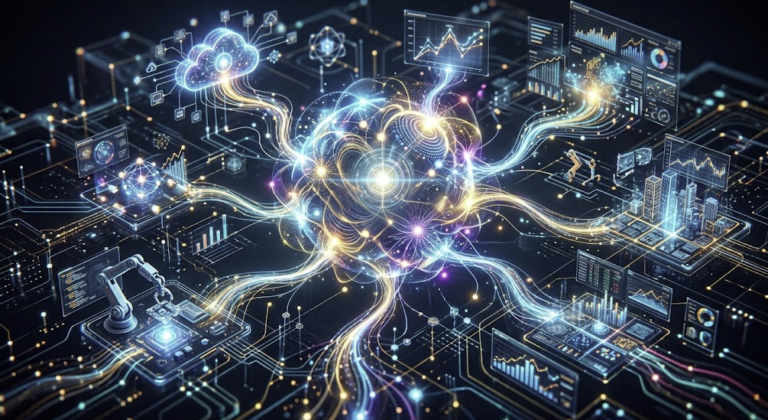
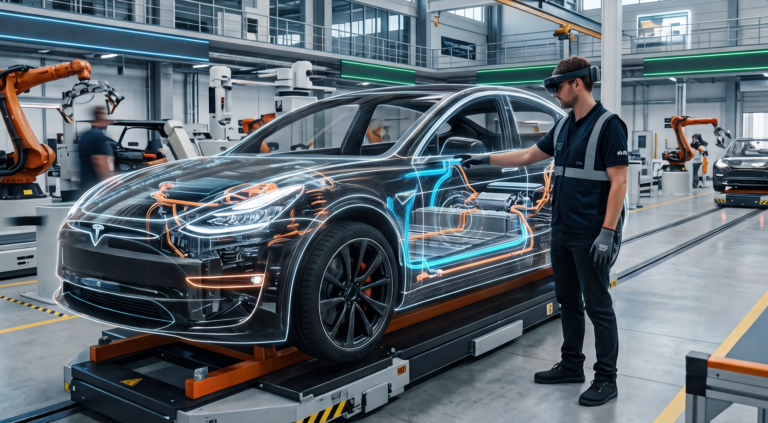
At their core, digital twins are virtual replicas of physical systems, but when combined with AI, they become far more powerful. AI-powered digital twins integrate real-time IoT sensor data and other diverse data sources with dynamic, physics-based 3D models, enabling organizations to simulate, predict, and optimize everything from factory floors to supply chains.
These systems can run complex “what-if” scenarios, detect anomalies, predict maintenance, and even automate certain controls, transforming digital twins from static visualizations into intelligent, self-learning, multi-purpose decision-making tools. The shift is unlocking tangible benefits like improved energy efficiency, faster planning cycles, reduced operational risk, and increased productivity.
More importantly, it’s allowing companies to fundamentally rethink how they design products, manage operations, and scale sustainably. Discover how two real-world organizations are using AI-powered digital twins to tackle increasingly complex business challenges while laying the groundwork for smarter, more efficient, and more sustainable industries.
Designing the Future of Sustainable Air Travel: JetZero
It’s surprising to learn that basic commercial aircraft design hasn’t changed much in decades. The long, cylindrical airplanes that we’re used to have inherent limitations, contributing to passenger bottlenecks, inefficient airflow, and noise pollution. U.S.-based startup JetZero is on a mission to update traditional aircraft design for a decarbonized future with the Z4, a 250-passenger “blended wing body” airplane and the first of its kind to be fully simulated from the start.
The novel design of the Z4, which blends the fuselage into the wing, aims to improve fuel efficiency by up to 50%, reduce noise, and support the goal of zero carbon emissions by 2035. But what makes JetZero’s approach particularly innovative is its reliance on digital twins to virtually simulate both the aircraft and the plant that will produce it.
In collaboration with Siemens, JetZero is leveraging comprehensive digital twins of the Z4 and the factory it plans to build in Greensboro, NC to test and optimize every aspect of the aircraft and manufacturing process, including raw materials, aerodynamics, assembly workflows, and supply chain logistics. By simulating the entire lifecycle before ever breaking ground or taking to the skies, JetZero can identify inefficiencies, validate designs, and scale processes early, thereby reducing risk and accelerating time to market.
AI also plays a central role, making it possible for engineers to explore more design options and run more accurate simulations in less time while machine learning models will analyze real-world performance data, creating a continuous feedback loop that helps refine the aircraft and its production.
Beyond building a better plane, JetZero is setting a new standard for the aviation industry, demonstrating that designing around sustainability can lower costs, unlock efficiencies, and improve profit margins while also enhancing the passenger experience. As an added benefit, the new factory is expected to generate thousands of jobs.
Reinventing Supply Chains: PepsiCo
How do you raise production and distribution capacity without building new facilities? Ask PepsiCo. Facing rising demand and faster innovation cycles, the food and beverage giant is rethinking traditional factory expansion through a multi-year collaboration with Siemens and NVIDIA to deploy AI-powered digital twins across its manufacturing and supply chain.
Using Siemens’ Digital Twin Composer and NVIDIA’s Omniverse platform, PepsiCo is creating highly-fidelity 3D digital twins of its factories and warehouses, replicating every machine, conveyor belt, pallet route, and operator movement to establish a baseline of operational performance.
AI agents then act as co-designers, stress-testing (simulating) new layouts and workflows before any physical modifications are made. The approach allows PepsiCo to uncover hidden capacity and improve efficiency within existing facilities without the cost and disruption of building new ones. Simulations help identify up to 90% of potential issues in advance, enabling teams to optimize and validate new configurations in a matter of weeks instead of months.
Early pilot programs at select U.S. sites are already delivering compelling results, including a 20% increase in throughput, nearly 100% design validation, and 10-15% reductions in capital expenditures.
Given the scale and complexity of PepsiCo’s operations, greater visibility and adaptability is becoming essential. The newly announced collaboration comes as supply chains grow more intricate and consumer expectations continue to rise, marking a key step “toward a world in which every plant and warehouse operates as part of a single, intelligent ecosystem.”
From Simulation to Strategy
These examples point to a fundamental shift: Digital twins are no longer just visualization tools. Powered by AI, they’re becoming decision engines. By processing real-time data and running advanced simulations, these systems enable organizations to identify and resolve issues before they occur, optimize performance across complex, interconnected processes, reduce operational risk and cost, accelerate innovation cycles, and improve environmental outcomes.
More broadly, the rise of AI-powered digital twins reflects how enterprises are moving toward smarter, more adaptive operations. Instead of reacting to problems, companies aim to anticipate and prevent them. And while efficiency and cost savings are the primary drivers, sustainability is an important secondary benefit. Digital twins help optimize energy use, reduce waste, and improve resource allocation, lowering organizations’ environmental footprint without sacrificing profitability and proving that efficiency and sustainability can go hand-in-hand at scale.