Robotics: Where Digital Twins and Physical AI Collide
Why Physical AI Needs Digital Twins
If physical AI is going to work in the real world, enterprises need a way to test it before it takes action. That may sound obvious, but it’s one of the biggest challenges facing AI in physical environments.
Software AI can be tested in sandboxes. AI agents can be limited, monitored, and rolled back, with failures typically contained behind a screen. But once AI is connected to robots, vehicles, machines, and other physical systems, the stakes change. A system that applies the wrong amount of force, fails to detect a hazard, or makes a bad decision near people or equipment can cause physical harm, damage, and disruption.
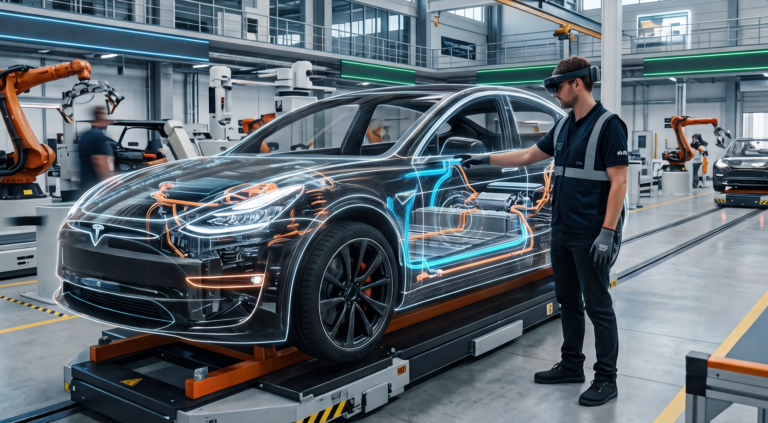
This is why physical AI cannot scale on models and hardware alone. It needs a proving ground where systems can be trained, tested, and validated before deployment. Digital twins provide virtual environments where AI can learn, fail, adapt, and prove itself without putting people, assets or operations at risk.
(A digital twin is a virtual replica of a physical asset, process, facility, or system. Unlike static models, it’s continuously updated with real-world data, allowing it to reflect changing conditions and help companies better understand and predict how physical systems behave.)
The testing problem
A central challenge with physical AI is that it cannot learn entirely by trial and error in the real world. While that may work in a software simulation, it’s unacceptable in an industrial setting such as a live warehouse. You don’t want a robot “figuring things out” by crashing into equipment or people.
Industrial environments are also constantly changing: lighting shifts, people move unpredictably, equipment wears down, parts arrive slightly out of spec, routes become blocked, etc. AI trained only on ideal conditions will struggle with variability.
This is especially important because physical AI is designed to be adaptive. Unlike traditional automation, which performs fixed tasks in controlled environments, physical AI must perceive, interpret, decide, and adjust in real time. That flexibility is what makes the technology valuable, but it also dramatically increases the number of scenarios that must be tested.
Digital twins as training grounds
A robotic arm that can adjust its grip, for instance, must train on many different object shapes, sizes, textures, and orientations. An autonomous warehouse vehicle must prepare for scenarios involving people, forklifts, pallets, narrow aisles, and temporary obstructions. An inspection system must recognize not only obvious defects but also subtle anomalies, rare conditions, and challenging edge cases in poor lighting and cluttered workspaces.
Digital twins expose physical AI systems to thousands of scenarios without requiring every condition to be recreated in the real world. Rather than rely solely on data from live operations, organizations can simulate rare failures, unusual operating conditions, and safety incidents before a system encounters them in production.
In this way, digital twins become a core part of the AI development process–a faster, safer, more comprehensive, and cost-effective approach to training and testing.
Synthetic data and edge cases
Digital twins are also valuable for generating synthetic data, or artificially created data that closely reflects real-world conditions. For physical AI, this might include simulated images, sensor readings, movement patterns, system states, etc.
Real-world data is often incomplete, difficult to obtain, and expensive to collect. In many industries, capturing edge cases like rare defects, blocked routes, or equipment malfunctions is slow, costly, dangerous, or simply impractical. Digital twins can help fill those gaps by generating training data for scenarios that are rare, resource-intensive, difficult to observe, or unsafe to reproduce physically.
Of course, synthetic data is only as good as the simulation behind it. A digital twin that’s too clean, simplified, or disconnected from actual operations can create false confidence, where systems perform well in simulation but fail in production. The goal is not to replace real-world testing but to make testing broader, safer, and more systematic before the system reaches live operations.
The sim-to-real gap
That brings us to one of the key challenges of using digital twins to train physical AI: the gap between simulation and reality.
A robot may perform well in a digital twin because the simulated environment is controlled and predictable. Floors are perfectly flat, sensors are accurate, objects have precise physical properties, lighting is consistent, and human behavior follows modeled patterns. Yet in a real facility, the system may encounter dust, glare, vibration, damaged labels, unusual human behavior, network latency, imperfect calibration, etc. This difference is often referred to as the sim-to-real gap.
Digital twins are not a complete solution to the problem, though they can help narrow it. The more accurately a twin reflects real assets and operating conditions, the more effective it becomes for training. Continuous calibration is critical. As facilities evolve, equipment degrades, workflows change, and new sensor and operational data becomes available, the twin must stay connected to reality.
From training to validation
Digital twins can also help enterprises validate physical AI systems before deployment. Validation is not the same as training; it doesn’t teach the system to perform a task but tests whether it can behave reliably, safely, and predictably under key conditions.
Before deployment, companies need to understand how a system behaves when conditions change. What happens if the environment shifts unexpectedly, sensors provide conflicting information, or a software update alters system behavior? When does the system slow down, stop, or request human intervention?
Beyond scenario testing, digital twins support stress testing, safety analysis, workflow validation, operator training, and version comparison before production updates. Models are updated, sensors replaced, workflows adjusted…each change can affect real-world behavior. In this way, digital twins also become part of the governance process.
Monitoring after deployment
A live digital twin can help organizations monitor how a physical AI system is behaving compared to what’s expected. If a robot begins taking longer routes, applying more force than usual, or missing certain objects, the twin can help identify where performance is diverging from the model.
That’s especially useful in complex environments where no single operator can see the entire system at once. A facility may have many machines, robots, vehicles, sensors, people, software systems, safety procedures, maintenance schedules, inventory, production targets, etc. Digital twins can reveal how these components interact, where bottlenecks are emerging, and how changes in one part of the system affect the rest.
Why this matters for enterprises
In enterprise, the digital twin conversation is often framed around efficiency, optimization, and planning. Physical AI introduces another dimension where digital twins are part of the trust infrastructure for autonomous systems.
Not every deployment requires a fully immersive, real-time twin. The level of fidelity should match the use case. A controlled robotic cell may need a simpler model than a distributed fleet of robots operating across multiple sites.
The goal isn’t perfect simulation but sufficient insight to understand how a system is likely to behave before granting it more autonomy. Digital twins are most valuable when they reduce uncertainty, expose edge cases, support validation, and improve monitoring.
The future of physical AI doesn’t hinge just on better robots and more powerful models. It depends on building systems that make physical AI safe, useful, and governable. Digital twins are one of those systems, a way to rehearse before reality.