
By Industry

Embracing Digital Transformation: Real-life Use Cases in Energy and Utilities
A handful of utilities are piloting and, in a few cases, even deploying wearable technologies, but the greatest share of interest is and has been around augmented reality. There is an impressive, concerted effort in the utility space by researchers and vendors to thoroughly investigate the technology to see if it’s safe and a right fit for the industry. The Electric Power Research Institute (EPRI) has taken on a great deal of forward-thinking testing of AR, recognizing that standards will have to be determined if there’s to be widespread adoption. EPRI EPRI has been a part of several companies’ efforts to pilot AR in electric and utility operations, including Duke Energy and Con Edison. With Duke, EPRI deployed Atheer’s AiR platform to demonstrate how hands-free AR improves productivity and safety and shortens power outage recovery time. In addition to enhancing power restoration, another possibility is using AR to bridge the techno-generational divide. In other research, EPRI is studying the health and safety impacts of AR on workers, keeping an eye out for risks like eyestrain and reduced situational awareness; and sensor-equipped non-AR wearables that can help keep workers safe. Duke Energy Duke’s emerging technologies unit has been a lead experimenter […]
6 min read

Empowering the Power Sector: The Use of Wearable and Immersive Tech in Utilities
Today’s power and utility companies are navigating a period of uncertainty: Political, environmental and social pressures are making it critical for the power sector to evolve the technology and business models by which it has traditionally operated. Radical policy changes such as regulation rollbacks and tax reforms, severe weather including historic floods, hurricanes and fires, a rapidly retiring workforce and changing electricity needs are testing utilities, compelling them to embrace digitalization… with caution. And it’s not just in the U.S.; energy markets around the world are changing. As power grids become smarter, electricity gets cleaner, and consumers have more choices; utilities are rethinking how they generate and sell electricity, how they can make their operations more intelligent and give customers more control while safeguarding reliability, affordability and safety. State of the Power Sector: Trends and pain points Changing Fuel Mix Power generation today is increasingly diverse and decentralized. The rise of cheaper renewable and distributed energy sources has led to a kind of fork in the road: How do traditional energy providers strike a balance between maintaining and repairing aging infrastructure and investing in the future? The trends towards grid parity and liberalization of the energy market are clear: 50 […]
6 min read

Over 20 Use Cases of Smart Glasses, VR Headsets, and Smartwatches at Airports
If going through airport security is a flyer’s biggest pain, then capacity is the airport manager’s living nightmare: Airports around the world today are hard-pressed to process more passengers and cargo than their terminals were originally designed to manage, and projected air traffic growth indicates no coming relief. Most American airports were built between the 1950s and 1970s. Take Chicago O’Hare International Airport: By 1975, O’Hare was the world’s busiest airport, handling 37 million passengers a year. In 2017, more than double that number – 79.8 million people – traveled through O’Hare, along with 1.9 million tons of cargo! Capacity issues have led to a multibillion-dollar infrastructure crisis in the airport industry, not to mention low customer expectations on the part of airlines and airline passengers (airports’ two main customers). It’s not enough for the industry to work on quickly processing travelers and avoiding delays; improvements and solutions are needed for the end-to-end travel journey, as well, including the terminal experience and flying between destinations. The pressure is on for airports to invest in new technologies that improve the efficiency of airport processes and reduce service disruptions; thereby allowing passengers to spend less time in queues and more time enjoying […]
8 min read

EHS 2.0 with Digital Advancement: How General Electric is Digitizing Safety
Improving worker safety is a mission that never seems to end. Hazards in the workplace are always evolving, as are the gear, tools and methods developed to mitigate risks. Our understanding of safety in the workplace is also evolving: For instance, though it’s hard to quantify, we know that safety has a great impact on productivity. Nevertheless, according to Nationwide, 51% of businesses don’t have an Environmental, Health and Safety (EHS) specialist on staff while 38% don’t offer any formal safety training. Though wearable technologies, including body-worn sensors, heads-up displays and robotic suits, are being touted as promising safety solutions for industrial workers; it was only two years ago that the U.S. Bureau of Labor Statistics reported the highest number of work-related deaths in nearly a decade. The rise of fatal injuries on the job, however, does not mean that wearables aren’t ready for primetime or that companies aren’t using them. It means organizations are not yet leveraging these technologies to their full capacity as part of a larger, connected and proactive system for safety in the workplace. There are, in fact, effective wearable safety devices today. According to Sam Murley, EHS Digital Acceleration Leader at GE, General Electric is […]
7 min read

Making Your Next Flight Safer and Smoother with Wearable AR+VR
From building the actual plane to the in-flight experience, wearable XR (AR, VR, MR) devices have a role to play in multiple professions within the commercial aviation industry. Employees whose jobs affect every aspect of one’s trip, including aircraft maintenance workers and flight crew can make use of wearable XR technologies to ensure the end goal: A safe and satisfied traveler. Find out how XR might be used on the ground and in the air when you go on your next business trip or vacation: On the Ground: AR for Assembly Both Airbus and Boeing employ augmented reality (AR) glasses in the aircraft assembly process. Airbus workers follow plans directly in their field of view, superimposed on the plane’s interior during cabin installation. They use the same solution to check the accuracy and quality of their work (image recognition technology and artificial intelligence at work); while Boeing employees use smart glasses to view a heads-up, hands-free roadmap for wire harness assembly over their real-world view. In each case, AR functions to form a stronger connection for the user between textual or diagrammatic instructions and the real working environment. Using AR glasses with software by Upskill helped Boeing save tens of […]
6 min read

Setting Up An Inventory System Is As Easy As 1-2-3…4
Written by Special Guest Bloggers Robert Seward and Steven Lewis, Co-Founders at Rendered Perception Computer Vision (CV) and Augmented Reality (AR) coupled with Artificial Intelligence (AI) will create that step change for inventory improvement that you are looking for. A good inventory system is a byproduct of having a deep understanding of your customer. Through our years of experience, that means you must be relentless about delivering a great customer experience. If you truly understand your customers’ jobs to be done, you will innovate and hire the correct product. More importantly, it is about progress not just a static product or service. There are plenty of off-the-shelf inventory management platforms for purchase but creating the best-in-class experience cannot be pulled from the shelf. When building an end-to-end inventory system, it should be set up in a way to collect insights, learn, teach, predict and understand customer circumstances. We will describe how setting up an inventory system is as easy as 1-2-3…4. Step 1. Pain points: Understanding Customer Friction First, you must dig into all the pain points, rationalizing customer friction points. In creating any solution, we first fall in love with the problem. We employ a 5-D method: Discovery, Define, […]
7 min read
Driving Ahead: Car Companies Using XR to Adapt in a Post-Uber World
My last blog post built upon Uber’s wrecking ball-style entrance into the cab industry. Less obvious is Uber’s impact in the automotive sector, where the app is creating waves for car manufacturers. Ride-sharing is just one of the trends forcing the auto industry to transform. In fact, some industry observers believe automotive is about to have its most dramatic revolution since Henry Ford’s time. State of the Auto Industry Changing Attitudes Towards Vehicle Ownership and Declining Sales Private car ownership is becoming less and less necessary, practical and desirable in many cities around the world thanks to the rising costs of urban living, civic measures to discourage car use, worsening traffic and lack of parking, and always-available services like Uber and Lyft. More car ownership trends: As cars have become more reliable, people are holding onto them for longer or opting for used cars. Delayed by student debt and economic uncertainty, young professionals aren’t moving to the suburbs like their parents did; and younger Americans simply prefer ordering a car via app to owning one—all reasons why vehicle sales declined in 2017 for the first time in years. This downward trend will likely continue; for while ride-hailing makes owning a […]
7 min read
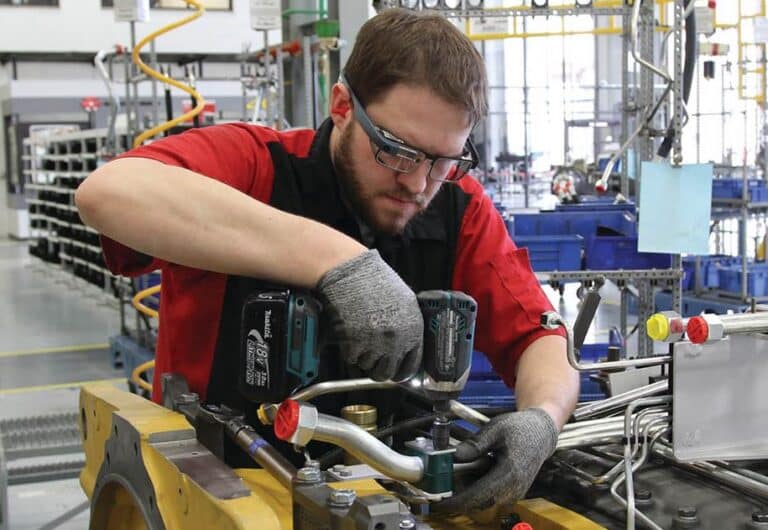
Manufacturing 4.0: Checking In with Expert Peggy Gulick of AGCO
A true enterprise wearable tech pioneer, Peggy Gulick, Director of Digital Transformation, Global Manufacturing at AGCO Corporation, spearheaded one of the most successful use cases of Google Glass in enterprise to date. Where others saw challenges, Peggy and her team saw opportunities to turn a device that was then (2013) struggling to find a purpose into a powerful lean manufacturing tool. We last interviewed Peggy in July of 2016, before she first graced the EWTS stage. Since then, AGCO has become a poster child of Glass Enterprise, the second generation of Google Glass developed with the input of enterprise visionaries like Peggy; and Peggy herself has become a star speaker, her story undoubtedly inspiring many others. Below, Peggy answers our questions about the state of manufacturing today: BrainXchange: What are the greatest challenges faced by manufacturers today? PG: All manufacturers that I have spoken to seem to face similar challenges with rising employer costs (many related to healthcare) and the need to reduce operational costs while projecting longer-term strategic plans. In addition, the expectations on employers by employees and the communities that they exist in have changed. Employees expect more from their employers, including a sense of purpose. Communities expect […]
6 min read

2017 was the Year of Store Closings–Can the Internet of Things Solve Retail’s Woes?
The Internet of Things (IoT) is a network of Internet-connected objects that have been made “smart” with embedded sensors. These devices collect data about the physical world around us, about processes and the health and behavior of people and machinery—data which is then interpreted and shared with other machines and people via cloud-based software platforms. In retail, IoT solutions can improve in-store operations, optimize supply chains, deliver better customer experiences, and generate new revenue streams. 2017 was the year of store closings. By year’s end, major retailers will have closed or announced plans to shutter over 8,500 stores. This in addition to the many brick-and-mortar retail bankruptcies, as e-commerce giants and fast fashion brands threaten traditional retail business models. How to solve retail’s woes? Is the future bleak for the industry? Has online shopping won or might the physical store survive with a little TLC and IoT? Consumers today expect the shopping experience to be seamless across all of a retailer’s channels. That includes the brick-and-mortar store, e-commerce site, mobile app and even telephone customer service. So, when we talk about the Internet of Things in retail, we’re not just referring to the connected store of the future […]
7 min read

Just in Time: AR/VR Spark a Digital Renaissance in Aviation and Aerospace
About 20 years ago, Boeing, the world’s largest aerospace company, identified the need for a hands-free, heads-up technology in its operations. Flash forward to 2014, when a device fitting this vision (Google Glass) finally appeared on the scene. Today, the aviation and aerospace industries are experiencing a digital renaissance, and the timing is critical for several reasons: Demand is high Demand is being driven by two factors: 1) Rapidly aging fleets that need to be replaced or maintained at great cost; and 2) New, more technologically advanced aircraft needed to stay competitive. (Boeing, for one, has a backlog of some 5,000 planes it is under contract to build.) Next-generation aircraft boast features like advanced avionics, noise reduction capabilities, improved interior cabin designs, and greater fuel efficiency. Aviation and aerospace companies are under pressure to ramp up production to replace customers’ older fleets and supply them with state-of-the-art vehicles. And, of course, as demand for new aircraft rises so too does the need to operate and maintain those crafts. A talent gap is creating a need for fast, low-cost training As in pretty much all manufacturing sectors, the aviation and aerospace industries are dealing with a skilled labor crunch as experienced […]
8 min read

Could Wearables, AR/VR Fix Retail’s Brick-and-Mortar Problem?
I read an op-ed recently, the headline of which was “To save retail, let it die.” The author made a case for letting go of our notions of what a traditional retail store should offer and instead embracing emerging technologies as a means to transform brick-and-mortar retail into something new. Rather than a place with a large inventory of products for customers to browse, try on and buy; the author predicted that physical retail spaces will become a destination for shoppers to experience something they can’t get online, something that can’t be delivered to their homes. Products won’t disappear from stores but sales won’t be their main purpose—they will be dynamic spaces for brands to engage and build relationships with consumers; where consumers will be able to have exciting product experiences (in AR and VR perhaps,) learn and be entertained. If the retail industry were to save itself this way, actual sales might never occur onsite but the inspiration or impetus behind them would; and today’s retail spaces and operations will need to be redesigned, re-staffed and re-managed to make it all possible. Sleek, minimalist stores that focus on customer experience as opposed to stocking and moving inventory (picture the […]
6 min read

Why the Logistics Industry is Going Hands-Free
The logistics industry has been thinking hands-free for years now. In my research for this blog post, I came across an article from 2007 on the use of voice headsets and arm-mounted computers in the warehouse. More recently, ABI Research found that 61% of logistics companies it surveyed are adopting wearable technologies as part of their technology innovation strategy. In addition to logistics companies, enterprises in other verticals are using wearables within their warehouse or supply chain operations. Below are some of the top use cases: DHL The number one wearable use case in the logistics industry today is arguably vision picking with Augmented Reality glasses like Google Glass and the Vuzix M300. DHL has been exploring wearables with its customers and in different units of its business for several years. In 2014 with the help of Ubimax, DHL Supply Chain and DHL customer Ricoh carried out a successful vision picking pilot in a warehouse in the Netherlands. For the pilot, staff went about their picking duties, taking cues from simple graphics and text displayed in smart glasses to navigate the warehouse and locate each pick. The glasses allowed for hands-free order picking, which sped up the picking process and […]
6 min read
Augmented Enterprise Newsletter
Get bi-monthly insights on AI, XR, digital twins, and related emerging enterprise technology delivered to your inbox.