
By Technology

AREA Webinar: Why and How to Introduce Enterprise Augmented Reality
1 min read
Three Reasons Why Google Android Wear Could Take a Bite Out of the Apple Watch
Written by Special Guest Blogger Andrew Levy, Co-Founder, Crittercism The wristwatch has been a fashion accessory for almost 450 years – but today, technology has transformed what was once a mere timepiece into a $30 billion industry. At the heart of this movement is the Apple Watch, a reimagining of the wristwatch that has turned the space on its ear by marrying wearable tech wizardry with sleek, modern design. With the inclusion of tech, something else interesting has also happened to the humble wristwatch: It’s developed the potential to be a valuable business tool as well. With 38 different watches available, Apple has called its Watch the most personalized device it has ever created. But there’s still a chance for a competitor – like Google Android Wear – to take a bite out of the Apple Watch market share – and enterprise usability just might be a key point of difference. Android Wear devices offer many tools and services that can positively impact the daily life of corporate users. Android Wear’s biggest value-add for both regular consumers and professional users is the ability to communicate through the smartwatch itself. Since it syncs to your phone, all of your alerts and […]
5 min read
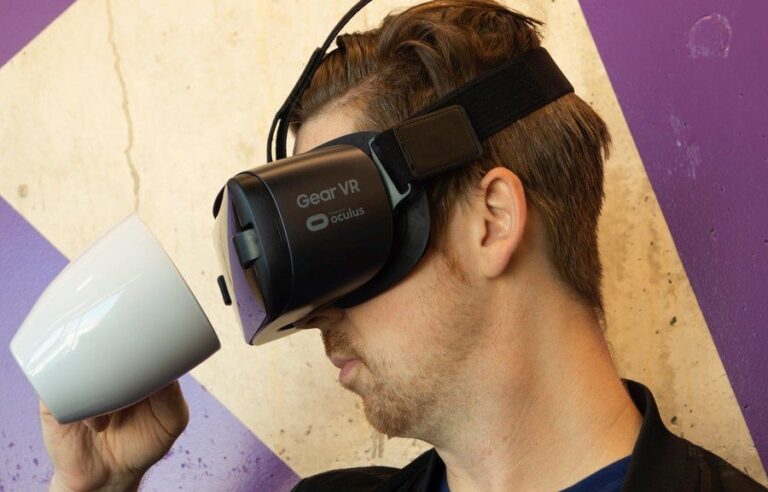
Industrial Applications Highlight the Need of Flexible Displays for Large Field of View in Virtual Reality Headsets
Written by Special Guest Blogger Tony Sun, Lux Research, the leading research partner of the Enterprise Wearable Technology Summit 2015 Virtual reality (VR) is not just for gaming or entertaining: the immersive interaction experience makes VR headsets a useful tool for design and training in many industries like automotive, construction, military, education, and health care. In fact, such technologies are already adopted by companies like Ford, which uses VR technologies to understand how customers experience its cars. However, current VR headsets are not for everyone to enjoy: some people will suffer from nausea due to motion sickness, which raises very real safety concerns of wider VR adoption in an industrial setup. One of the key elements to solve the motion sickness issue is to have a large field of view (FOV), the extent of the observable world that is seen in the VR headset. Currently, there has not been a VR headset specifically for industrial applications. Industrial developers often pick major consumer VR headsets with a single screen for display, such as Oculus Rift, as the platform. These headsets typically offer FOVs of 100° to 110°. There are also VR cases with FOVs of 90° to 105°, such as Google […]
3 min read

Voice-Based Wearables in the Enterprise
Written by Special Guest Blogger Aditya Kaul, Tractica Voice control is a powerful tool, especially when it comes to performing hands-free tasks in an enterprise setting. Voice-based wearables have been successfully implemented in the enterprise, especially in retail or warehouse environments, and have proven to be highly effective in speeding up tasks such as picking and sorting, improving accuracy, and increasing productivity as a whole. Employee communication on the shop floor is another application where voice-based wearables have been used. When compared to the use of handheld scanners in warehouse environments, or walkie-talkies on retail shop floors, voice-based wearables are easier to learn, set up, and operate. Honeywell’s Vocollect and Theatro are two voice-based wearable solutions currently on the market. The two solutions are similar in functionality, in the sense that voice is the main input and output technology, doing away with the type of display screen that is usually present in smart augmented reality glasses. Both also come with a sophisticated backend system, which can be customized for any warehouse environment, converting a warehouse inventory list into a voice-based querying and entry system. Honeywell’s Vocollect has a traditional form factor for a wearable with a headset and microphone. The […]
3 min read

Smart Glasses: Perfect for the Enterprise
As has been declared in countless reports, articles and blog posts, smart glasses are game changing technology for the enterprise, if not as esteemed by consumers. Indeed, while consumers have been slow (to say the least) in adopting the technology, numerous publicized business use cases have proven that smart glasses like Google Glass and the Vuzix M100 are valuable to enterprise and here to stay.What makes smart glasses so apt for business, whereas smart watches are more of a consumer phenomenon at the moment? It’s the “see-what-I-see” aspect of the head-mounted devices. The ability to share a unique, first-hand viewpoint with a colleague, expert or customer remotely and in real-time is what distinguishes smart glasses from other wearable technology; and what makes Google Glass and the like ideal for the innovative approach to customer service that companies such as Hewlett Packard are now taking.Below is another great video featuring EWTS ’15 thought leader Garry Orsolini. In the video, Garry describes HP’s Visual Remote Guidance for the enterprise, an initiative in which smart glass technology is utilized to facilitate real-time and remote problem solving between HP and its enterprise customers. Enjoy!
1 min read

How Google Glass Improved HP’s Graphics Solutions Business
W’ve been exploring some of the fascinating ways in which HP is revolutionizing their business through the use of wearable technology. The applications for using wearable tech like Google Glass in a variety of enterprise environments have been relatively well-documented in the media; but less covered are the real-life benefits of using smart glasses and the like to an organization and its day-to-day operationsSure, the idea behind heads-up and hands-free technology makes perfect sense for business…in theory; but can wearable tech actually improve workplace productivity and the overall efficiency of organizations as promised? HP’s Graphics Solutions Business team is “living proof” that wearable technology can indeed make your business better and more effective. In the video below, HP’s John McMahon describes how the Graphics Solutions Team employed Google Glass to maximize the up-time of its customers’ printing solutions and create a whole new (and improved) customer service experience.Use cases like the one described in HP’s video clearly indicate the incredible, trans-formative potential of wearable technology in the enterprise.
1 min read
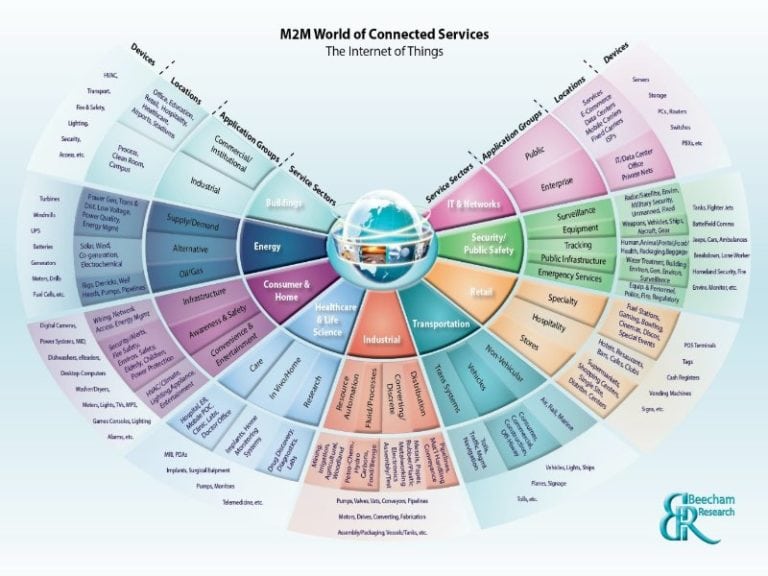
From M2M to the IoT Vision and the Role of Wearable Technologies
Written by Special Guest Blogger Saverio Romeo, Beecham ResearchThe M2M market is gaining the momentum that it has deserved for a long time. The use of machine-to-machine technologies is spreading in many sectors, transforming the way different organizations operate and showing real flow of revenues. M2M products and solutions are no longer “nice to have” but strategic to organisations. Business models are moving beyond connectivity, increasingly becoming service-led and data-rich. The market is also moving from an application-centric approach – one business problem and one set of data – towards an environment-centric approach (the Internet of Things) in which different data come different sources and devices. Therefore, we start talking about smart spaces and wearable devices as interfaces between smart spaces and people. This article will explore that evolution. Development Trajectories of the M2M Market Initially, the M2M market was driven by the so-called “after-market applications”. The After-market category of applications usually involve retrofitting connectivity to products already installed and working in the field. But, soon after, another route started to develop in parallel. Policy makers and regulators began to appreciate the importance of M2M for the modernization of certain sectors. In Europe especially, they started legislating in order to […]
4 min read

Top 5 “Other” Wearables for Business
Smart glasses, smart watches, and fitness trackers may steal all the headlines but there are many other types of wearable tech for enterprises to explore; indeed, there is much more out there in this budding area of technology than just the Apple Watch, Fitbit, and Google Glass. New wearable devices launch virtually everyday, from smart socks to digital tattoos, on top of the two-dozen smart glasses models “in the works” plus the dozen smart watches already on the market. The choice for enterprises comes down to the use case: Where on the body is information best glanced and/or sensed for a particular task or initiative? Below we outline 5 categories of wearable devices that have already been put to the test in the workplace or else stand to “make waves” in future enterprise applications. For a more complete description or discussion of each category, check out the long version of this post after the “short list.” Beyond Smart Glasses & Smart Watches: Top 5 Other Wearables for Business, the “Short List” One. Exoskeletons Exoskeletons are a rather extreme example of smart clothing (below) that offers augmented strength to the wearer. No longer just for the military, these suits promise extraordinary […]
9 min read

Augmented Reality and Wearable Devices
Written by Special Guest Blogger Saverio Romeo, Beecham Research It is not a surprise that the connection between augmented reality and wearable devices, primarily hands-free devices, is a promising one. Initially, it was an idea in the hands of science fiction writers and visionary technology thinkers, but today it is not just promising, it is desirable and it is real. Tremendous evolution in enabling technologies such as battery, user interfaces, sensors and processing has turned that connection into real products. And those real products are proving their positive impact in enterprises, obliterating the common, but false, understanding that AR and wearable devices were technologies just for gaming. Additionally, we are not talking about project testing, but we are talking about commercial deployments. The testing phase has proved that AR and wearable devices can enable easy access to knowledge systems in complex contexts, process optimization, and new levels of remote collaboration. Heads-up displays are used in manufacturing production systems for ensuring the right job procedure, in collaborative product design and prototyping, in remote assistance of distant specialised workers, and in surgery theatres for enabling the surgeon to access relevant data without being distracted from his or her main activities. The market […]
2 min read

Google Glass Never Died
You’ve probably seen many headlines claiming that Google Glass is dead, especially following Google’s January decision to stop selling the first version of Glass and end its Explorer program. This week, Google Executive Chairman Eric Schmidt spoke with the Wall Street Journal, essentially defending the vitality & significance of Glass. Whatever the future of Glass as far as its ultimate form factor, function, and price, I can personally confirm that the wearable device is indeed far from dead, at least in the enterprise. Here are 5 companies – some well-profiled in the news plus a few that are rarely cited – who are using or experimenting with Google Glass in exciting ways in the workplace. Virgin AtlanticOut of all the user cases I have come across, Richard Branson’s airline has perhaps received the most attention for its Google Glass trial at Heathrow Airport. Virgin agents at the London airport used Glass to welcome the airline’s first-class passengers & efficiently process them for their flight, all while maintaining eye contact. In this pilot, Google Glass was incorporated into a highly innovative customer service program, which to my mind indicates exciting changes for the future of the travel & hospitality industries. Security […]
3 min read
- ← Previous
- 1
- …
- 8
- 9
- 10
Augmented Enterprise Newsletter
Get bi-monthly insights on AI, XR, digital twins, and related emerging enterprise technology delivered to your inbox.