
By Technology

Digital Twins Find Their Way Into Data Centers and Cybersecurity Experts’ Toolkits
Intro Digital twins may be an emerging technology, but they’re not new. In the 2000s, digital twins promised a new era of product development and lifecycle management in manufacturing. Digital twins have since spread their wings into industries like automotive, utilities, and even healthcare. More recently, the technology is finding its way into some surprising/interesting spaces like telecommunications and cybersecurity. Data Centers Artificial Intelligence (AI) is extremely power intensive. This is due to the volume of data, complex algorithms, continuous operation, and high-performance hardware involved; and it’s driving data centers’ energy consumption (and costs) to unsustainable levels. How can data center operators balance the demands of AI with sustainability? Enter digital twins. You may be surprised to learn that data centers use as much power as large industries like airlines. AI is both powered by and used within data centers, where AI – or, really AI-powered digital twins – can help mitigate AI’s environmental impact. You read that right: AI can be used to mitigate its own impact through predictive maintenance and even AI-enhanced augmented reality support. That means the ability to predict potential failures, optimize maintenance schedules, and thus reduce downtime. By digitally replicating almost every asset and service […]
3 min read

An AI Primer for Businesses
What is Artificial Intelligence (AI)? AI is a branch of computer science concerned with training machines to mimic human intelligence in order to perform tasks ranging from simple perception to complex problem solving and reasoning. AI systems learn to simulate human cognitive functions by consuming/analyzing large amounts of data, looking for patterns, and creating rules or algorithms to inform decisions. You can think of AI as the broader concept or overarching field, under which there is machine learning, generative AI, agentic AI, etc. Enterprise AI is the application of AI within a company – across a range of functions (operations, customer service, sales and marketing, cybersecurity, etc.) – to solve complex problems, improve decision making, automate (routine) tasks, optimize processes, and drive innovation through new products and services. Current State of AI in Enterprise Companies are eager to harness AI for immediate gains in efficiency, agility and innovation (and to replace labor). We’re seeing great interest and rapid experimentation but not necessarily positive outcomes. Generative AI has arguably had the greatest mainstream success. A recent MIT study provides a sobering reality check, finding that 95% of enterprise AI projects fail to deliver measurable impact. The majority of AI initiatives aren’t […]
7 min read

Digital Twins in Action: Industry-Specific Use Cases to Know
We’re back with 5 more real-life examples of digital twins in enterprise. We’ve seen Petrobras and ENGIE employ digital twins for asset visualization, TotalEnergies for automation, SEACOMP for virtual tours, AB InBev for operational optimization, Toyota for robotic system programming, BMW for production planning, Lowe’s to optimize store layouts, Renault Group for vehicle design, and more. Now, learn how companies in automotive, finance, and beyond are leveraging digital twin technology for applications like innovation and stakeholder communication. CHEVROLET – INNOVATION The Corvette ZR1 is the “fastest street-legal production car available for less than $1 million.” Before setting a top speed of 233 mph on consecutive runs around a closed track in Papenburg, Germany last October, the ZR1 got its start in the virtual world. Since GM doesn’t own the Papenberg track, it would have just three hours to test the ZR1 on the “big day” in Germany. Thus, the team turned to VR to calculate every detail “from car alignment to tire pressure” in advance, starting with a highly detailed digital twin of the vehicle. When it comes to vehicle design, digital twins are usually used to track changes during development. In this case, the ZR1 team used the “virtual […]
6 min read

Seeing Success: The Business Value of Eye Tracking in XR
Most XR headsets today come with some form of tracking technology. There are sensors and cameras for eye tracking, hand tracking, head tracking, motion tracking, and spatial mapping…Eye tracking, in particular, is essential to most extended reality applications and rapidly advancing with AI. Eye tracking, however, isn’t new, with roots in marketing, medical and other research as well as gaming. With recent advances, eye tracking data is becoming easier to collect and, as a result, it’s becoming easier to train algorithmic models based upon this data. Eye or gaze tracking measures the direction of your gaze. Combined with hand tracking, head tracking and potentially additional biometric sensors like EEG, eye tracking can reveal all kinds of things about the user. Input & Foveated Rendering In VR, eye tracking has user interface and performance implications. As an input method, it makes virtual experiences more natural and comfortable. Gaze is a natural interface, and grabbing a virtual object by looking at it is more intuitive than a controller. When you infuse physical sensations by adding hand tracking and haptics, it can really feel like you’re touching a virtual object and it’s responding to your touch. The combo of gaze and gesture controls […]
6 min read

From Data to Power: What’s Really Challenging Digital Twins?
Two years ago, BMW Group’s Hams Hall plant began an effort to centralize its data gathering infrastructure. This particular plant produces approximately 1.4 million components and assembles around 400,000 engines per year for a range of vehicles, generating a vast amount of data in the process. That data, however, would often end up siloed, creating a serious operations oversight problem and the need, at one point, for internal teams to use more than 400 custom dashboards from 15 different IT systems. So, BMW created a digital twin of the Hams Hall plant as a single source of truth accessible to all team members. Now, “everyone refers to the twin.” The story of the Hams Hall plant reveals a significant challenge to leveraging digital twins: To get to an accurate digital twin – a single source of truth – typically involves integrating multiple sources of data of different types and access methods. Such a complex task is hindered by factors such as data management, accuracy, security, computing power, interoperability, and people. Here’s a brief overview of 5 key challenges for digital twins: DATA MANAGEMENT As one source put it, data is the “lifeblood” of digital twins. Most organizations, however, don’t have […]
5 min read
Teleoperation, Training, and More: Where XR & Robotics Converge
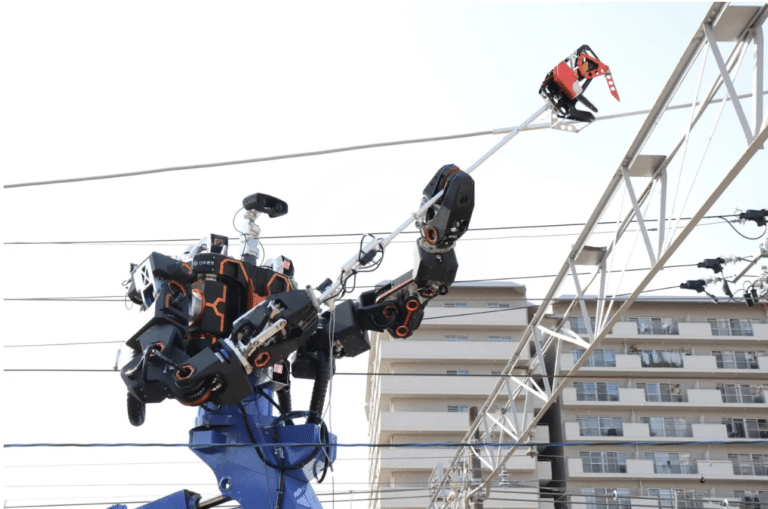
Asked to imagine a factory of the future in 2021, Boeing predicted that “immersive 3D engineering designs will be twinned with robots that speak to each other” while “mechanics around the world will be linked” by XR headsets. Four years later and this vision isn’t far off from reality. The use of robotics, especially in manufacturing, is nothing new, nor is the use of virtual reality (VR) for enterprise applications like training. Where these two technologies are converging, however, is another, still developing story. We’re seeing the rise of several VR-robotics use cases, including: The use of VR to train robots The use of VR to operate/teleoperate robots and The use of robots to scan environments and capture information for immersive applications INTRODUCTION Robots have been in use for some time, mainly to perform automated repetitive tasks in controlled industrial environments. I say controlled because traditional robots are rigid and unable to adapt to change, which can put human workers, expensive machinery, etc. at risk. In regards to VR, we’re interested in humanoid robots as well as robotic arms. To be more specific, we’re talking about humanoid robots that can carry out complex pre-programmed tasks, be operated remotely (especially in […]
8 min read

Evolving Concepts: Digital Twins, Digital Thread, and Beyond
In my reading, I’ve come across various terms and definitions for different types of current and future digital twins. These have expanded my understanding of the breadth of use cases for digital twins in enterprise now and in the future of work. Here’s what I found: Introduction Digital twins can actually be traced back to the 1960s when NASA used them to study and simulate real spacecraft. Though the concept isn’t new, companies are finally starting to realize the promise of digital twins. Advancements in AI, IoT, cloud computing, and more are helping to make digital twins more useful, powerful, and accessible to nearly every industry. According to McKinsey Digital, 70% of C-suite technology executives at large enterprises are exploring and investing in digital twins. For manufacturers in particular, some of the earliest adopters, digital twins can be seen as an evolution of traditional product lifecycle management tools. No matter the industry or asset – there are digital twins of simple machine components up to the level of entire organizations and cities – the goal of digital twins has always been to better understand the physical world. What is it? You often hear about the convergence of IT (information technology) […]
7 min read
How are enterprises taking the loss of HoloLens 2?
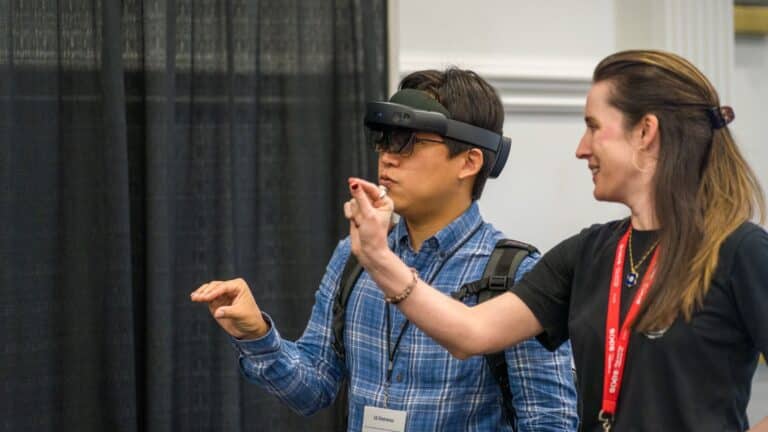
How are enterprises taking the loss of HoloLens 2? Which XR devices are they currently using? The following is based on the in-app topic discussions and responses started and shared by attendees of the 2024 Augmented Enterprise Summit. Mobile Reigns PTC created a poll during the conference asking attendees which XR device types they’re currently using or expect to use in the next two years. Keeping in mind that users were allowed to check more than one box, mobile devices came out on top with 75% of respondents choosing phones/tablets. Passthrough AR/VR devices like Meta Quest and Apple Vision Pro were a close second (65%); while 42% selected see-through AR devices like HoloLens and Magic Leap, and 27% reported using head-mounted tablet devices from the likes of RealWear and Vuzix. Top Headset In another poll, attendees shared their vote for “best overall headset value” out of HTC, Meta, Apple, and “Other.” Perhaps unsurprisingly, most chose Meta Quest (58.3%), followed by HTC with 29.2% of the vote. This may not reveal much given the options, but the results were seemingly confirmed in discussion topics: Users praised Meta Quest devices for their value, versatility, accessibility, and ease of use. Those who prefer […]
4 min read
Top Enterprise XR-Related Developments from CES 2025
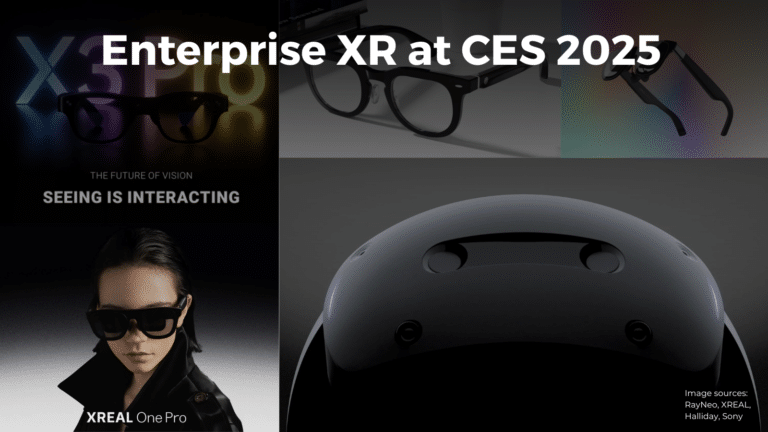
Didn’t make it to Vegas? We’ve sifted through the AI companion robots and smart kitchen appliances to bring you the top enterprise-related XR/spatial computing announcements and products from CES 2024: SONY The electronics giant announced a standalone mixed reality headset focused on “spatial content creation.” Developed with Siemens, the headset uses Qualcomm’s new Snapdragon XR2+ Gen 2 chipset (newer than the one in Quest 3) and boasts 4K resolution per eye, dual OLED microdisplays, a flip-down visor, and unique controllers in the form of a stylus/pointer and a ring. Sony made no mention of gaming; instead it’s targeting content creators, engineers, and other professionals in potential competition with Apple Vision Pro. Users can edit and shape 3D models while wearing the headset, creating a new way to model and explore 3D designs as well as create immersive training environments. The headset is slated for release later this year and will use Siemens’ Xcelerator software tools for enterprise. HTC HTC launched a $200 Full Face Tracker accessory that attaches magnetically to the Vive XR Elite headset to capture eye and mouth movements. Developers can use the eye and mouth tracking capabilities for a number of purposes including animating avatar faces more […]
3 min read
We’re at an Inflection Point for XR: Interview with Campfire CEO Jay Wright
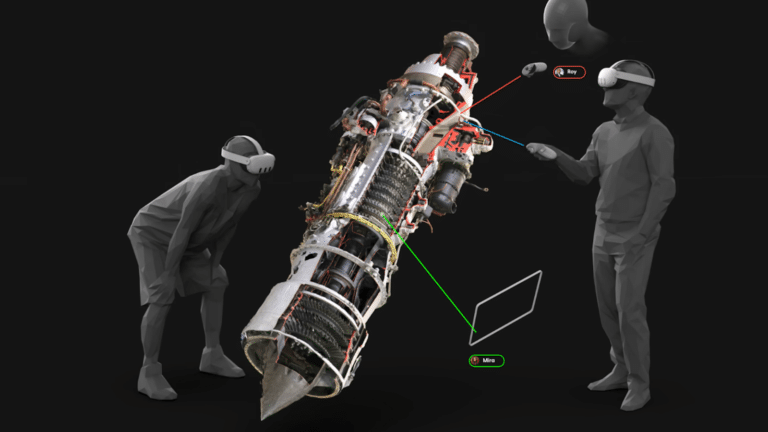
We had the opportunity to sit down with Jay Wright over Zoom. Jay is the CEO of Campfire, an easy-to-use software solution for sharing and reviewing 3D models with anyone, across existing desktop devices and a new generation of headsets. Jay will moderate the panel “Immersive Design & Visualization (Product Design, Prototyping, Asset, and Data Visualization) featuring speakers from Stryker, Walmart, Rolls-Royce, and more at the 2024 Augmented Enterprise Summit. Learn more about Campfire. Campfire’s Origin Story Emily: My first question is about the company name. What is Campfire’s origin story, and where did you come up with the name? Jay: It’s a pretty long origin story, but it came on the heels of a decade spent in immersive tech, running efforts at Qualcomm and then PTC. So, I was very familiar with the need [for XR]. Then, I was approached by some investors that had bought assets of a former immersive tech company called The Meta Company. It was kind of ashes at that point, and I saw an opportunity to take those ashes and turn them into Campfire. When we started, we were actually doing some hardware of our own. Now, because of Quest 3 and other devices, we’ve left […]
9 min read

XR & Enterprise Privacy & Security: Is the Metaverse a Giant Data Grab?
With trust in technology companies at an all-time low and seemingly every Big Tech company working on an XR headset to compete with Apple Vision Pro, it’s a good time to consider the privacy and security ramifications of extended reality in enterprise. Introduction Every new technology introduces new risks to an organization. Any connected device can become a source of real-time data breaches, phishing scams, or invasions of privacy. What makes XR different and potentially scarier are the sophisticated sensors and very nature of the tech: XR devices track highly personal information in order to alter the user’s perception of reality, either by augmenting (adding to) or essentially replacing one’s field of view. Privacy and security experts have expressed concerns about the kinds of company and personal data these devices collect, how that data is used, shared and stored, how to protect IP and personal identity in virtual worlds, how to safeguard augmented spaces, and more. Recently, their worst fears proved possible when researchers at the University of Chicago managed to “crack” a Meta Quest headset. Not only did they hijack users’ headsets and steal sensitive information, but they were even able to use generative AI to manipulate social interactions. […]
7 min read
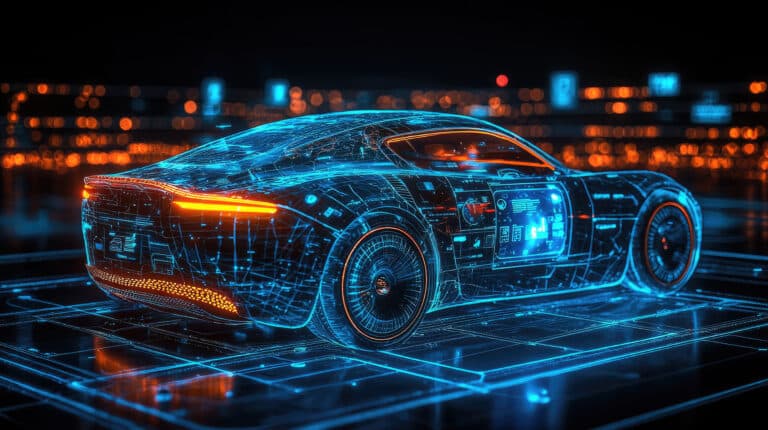
5 Examples of Immersive Digital Twins in Enterprise
3 min read
Augmented Enterprise Newsletter
Get bi-monthly insights on AI, XR, digital twins, and related emerging enterprise technology delivered to your inbox.