
By Technology

How Enterprises Really Feel About the Metaverse in 21 Statistics
With headlines like Mark Zuckerberg Quietly Buries the Metaverse, VR is dead, the metaverse is dead. Maybe. and The Metaverse is Dead. Long Live the Metaverse, it can be nearly impossible to get a good read on the current status and long-term viability of the metaverse. Don’t read too much into short-term changes in investment strategy or assume that Meta and other Big Tech companies are completely abandoning their AR/VR/MR (XR) efforts in favor of AI or another emerging technology. Scaling back millions of dollars in investment in the face of a down economy is not the death knell of the metaverse. Such actions don’t cloud outlook but rather set the stage for more realistic expectations and timelines. So, how do business leaders and employees really feel about the metaverse right now? Here are 21 recent statistics: Plans & Budgets 63% of CXOs across the U.S., UK, and Germany believe the metaverse will be a game changer that will transform many parts of their businesses, the main benefits including accelerated time to market, greater innovation, and more. (Wipro Limited) 78% of CXOs across the U.S., UK, and Germany said the metaverse will enable them to build new business models. 56% see the potential […]
4 min read

A Quick Guide to XR-Adjacent Technologies: Web3, Blockchain, and NFTs
We’re still trying to define the metaverse, and with some companies seemingly halting their metaverse efforts, enterprises want to know if the metaverse is or is not the next big thing. It is, but we need to adjust our expectations and timeline—the metaverse is inevitable in some form. We will don VR headsets to perform certain jobs, meet sometimes as avatars in a virtual office, and try immersive experiences from our favorite brands. Interest and investment will ebb and flow over the next few years as with any new technology, but we are undoubtedly heading towards a metaverse or multiple metaverses where the physical and digital worlds merge to enable new ways of working, socializing, shopping, learning, etc. With that said, there are many new terms and technologies associated with the metaverse. We went over 5G, edge computing and AI, but what about Web3, blockchain, and NFTs? Let me put it simply for you and me both: Web3 What is Web3 and how is it different from the metaverse? Web3 is the third generation of the internet, essentially a new, decentralized model for using and governing the internet. Developers are currently working on Web3, building new protocols and apps for decentralized […]
5 min read

Goodbye, Google Glass: Remembering Some of the Earliest Use Cases
It’s difficult to quantify the impact of Google Glass on the entire enterprise AR market. Glass really took one for the team, and I genuinely do not believe the space would be as mature or use cases as numerous as they are today had it not been for Glass. Glass Explorer Edition inspired some incredibly imaginative professionals who, either officially or (in many cases) unofficially, created some of the first augmented reality POCs in enterprise. Back in 2015, when the media was calling Glass a failure and outing Glassholes in public, we began the Augmented Enterprise Summit. We took a chance on a budding market based on the stories of those early Google Glass Explorers. Let’s look back at some of the earliest AR use cases from 2013 and 2014: Stock pickers at Dutch e-fulfillment company Active Ants wore Glass for hands-free pick lists, reducing errors and increasing their speed. BMW tested Glass at one of its U.S. plants for quality control of pre-series vehicles. Workers used the device to document issues to show engineers. Capriotti’s Sandwich Shop used Glass to record new workers’ performance and the lunchtime rush, hoping to spot areas for improvement. At Copenhagen Airport, airport duty […]
3 min read

A Quick Guide to XR-Adjacent Technologies: 5G, Edge Computing, and AI
Despite the hype and confusion of the present, the world – firstly the business world – is moving towards the metaverse. But what is the metaverse? What is XR’s role in the metaverse, and what does 5G, edge computing, and AI have to do with it? Though the word has come to encompass pretty much any XR experience, the metaverse can be understood as an emerging business model and social sphere bridging the physical and digital worlds. The metaverse is a lot of things – an extension of our work and social lives, a new frontier or marketplace for corporations to compete and target consumers, an ideal space for experimental or predictive simulation using digital twins, etc. – but one thing it is not is real. Instead, we have many different virtual worlds and immersive experiences requiring different devices, apps, profiles or avatars, and digital currencies to access. Moreover, the unified metaverse envisioned by futurists like Mark Zuckerberg might never come to fruition as it would require a level of cooperation and interoperability that’s hard to imagine in Big Tech as we know it today. So, why all the talk about “the Metaverse?” Many people refer to the metaverse […]
5 min read
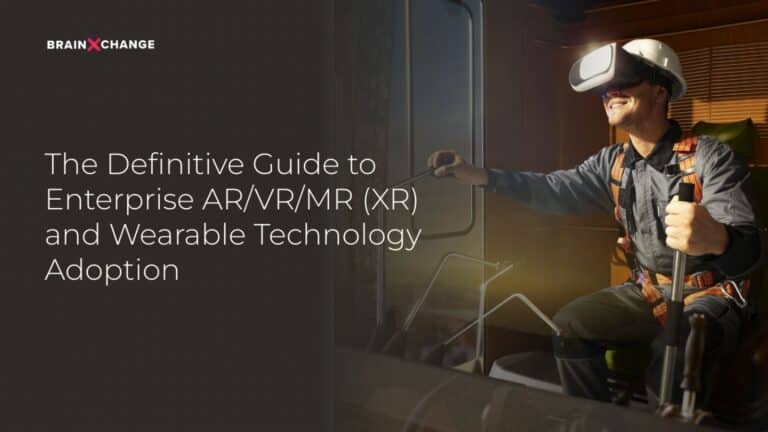
BrainXchange’s Definitive Guide to Enterprise XR and Wearable Tech Adoption
Over 8+ years and nearly 10 events, BrainXchange has enjoyed a front-row seat to a computing and workplace revolution that promises to make organizations and their workforces more agile, connected, and mobile than ever before. During that time, we witnessed the rise of numerous AR/VR/MR (XR) use cases and next-generation immersive devices and platforms influenced by the early adopters who shared their stories at our events. The Definitive Guide is the result of this experience and, more specifically, the product of hundreds of discussions with enterprise end users themselves.
1 min read
2022 Year in Review: Key Developments in the Enterprise XR Space
Last year, to summarize the 2021 XR market in three bullet points, I wrote, “1) Apple glasses rumors, 2) Mark Zuckerberg’s philosophical musings about the future of work, and 3) The Metaverse.” Well, not much has changed: Journalists are still analyzing patents and code to deduce Apple’s AR hardware plans, Meta and others are still refining their vision for the future of work, and we still don’t know if there will be one metaverse or many metaverses. Let’s see what the major enterprise XR market players were up to in 2022: AUGMENTED/MIXED REALITY After committing to OpenXR/WebXR support and reiterating its intention to target businesses, Magic Leap dropped its second-generation headset in September to enthusiastic reviews. Available in three editions starting at $3,300 for the Base model, Magic Leap 2 has twice the field of view and is half the size of its predecessor, and boasts major optics advancements: In particular, reviewers praised the headset’s reduced eyestrain and unique dynamic dimming feature. In February, a Business Insider report cast doubts on the future of Microsoft’s HoloLens mixed reality headset. Following this, Microsoft worked to position its full technology stack for the enterprise metaverse, forming an internal team in October to […]
6 min read

An Opportunity Too Big to Ignore: Metaverse Stats You Oughta Know for 2023
Did you catch our July roundup of 50+ intriguing metaverse-related statistics? We’re back with more (sometimes conflicting) research findings and survey results to inform your organization’s metaverse strategy in the coming year. Innovation 51% of companies are either in the process of integrating virtual reality into their strategy or have already built VR into at least once dedicated line of business. (PwC) 36% of executives say the metaverse will revolutionize business, while 82% expect metaverse plans to be a part of their business activities within three years. (PwC) 66% of business execs say their companies are actively engaged in the metaverse. (PwC) 46% of CIOs and CTOs “consider the metaverse to be very important to their innovation strategy.” (PwC) Energy companies are currently allocating 18% of their digital investment budgets to the metaverse. (Pew Research) Money The metaverse economy could generate up to $5 trillion in impact by 2030, “equivalent to the size of the third-largest economy today, Japan.” Much of that impact will be seen in e-commerce, followed by virtual learning, advertising, and gaming. (McKinsey & Company) Gartner places the enterprise digital twins market at $183 billion by 2031. Applications 86% of companies using augmented reality for onboarding say the technology has improved the […]
2 min read
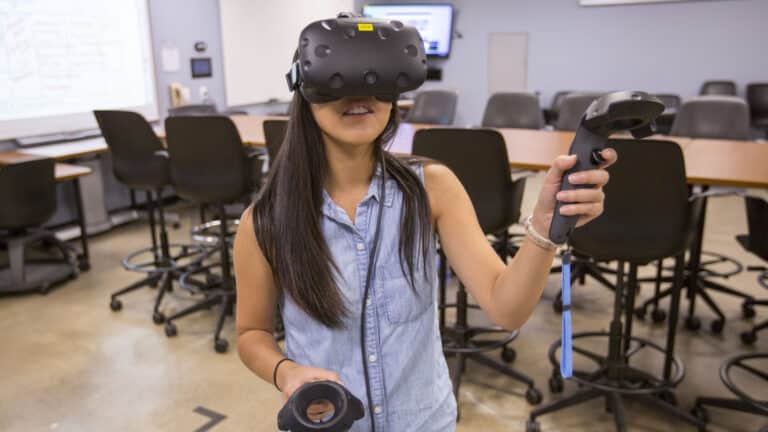
Higher Education VR Leaders: Interviewing SDSU’s Sean Hauze and James Frazee
Today’s higher education students are the workforce of tomorrow. Thanks to the efforts of James Frazee and Sean Hauze, many SDSU graduates will enter the professional world with experience using AR and VR technologies, becoming the first generation to use XR both at school and work. Enterprises should take note. One Emily, BrainXchange: To begin, could you provide us with a little background on yourselves and your career? How did you end up at SDSU? Dr. James P. Frazee: I am the Deputy CIO and Senior Associate VP for Learning Environments, Technologies, and User Services or LETUS at San Diego State University (SDSU). LETUS is a unit within IT that aims to support teaching and learning through active learning environments, pedagogical research, learner-centered technologies, and user support. We partner with faculty and other campus stakeholders as well as regional, national, and international higher education and industry partners to improve student success. Sean Hauze, Ph.D.: I serve as Director of Instructional Technology Services at San Diego State University, providing leadership and direction for applications, initiatives infrastructure, training, and support services across the broad spectrum of instructional technology functions. I also teach doctoral-level research methods and evaluation for the Department of Educational Leadership. […]
6 min read
Top Challenges of the Enterprise Metaverse
If you believe Mark Zuckerberg, we are no more than five years away from commuting to work via virtual reality headset, meeting colleagues as avatars, and spending much of our working lives (providing tons of data to Facebook) in VR. Five years is unrealistic considering the metaverse is still largely unformed. We’re at least a decade away from a persistent, interactive, and shared virtual world parallel to our own and accessed (ideally) through a single gateway. Nevertheless, millions of dollars are flowing into enabling and precursor technologies, and companies like Mercedes, Walmart, and HSBC are experimenting and filing trademarks to carve out a place in today’s most popular virtual worlds. Whether the next evolution of the internet, a dystopian Meta-controlled future, or a new way of labeling XR, the metaverse needs a lot of work before it can become real. Here are some of the biggest challenges to realizing the Metaverse. Privacy Privacy concerns top the list: In a December 2021 survey, 87% of U.S. adults reported feeling concerned about their privacy if Meta were to succeed in creating the metaverse (Statista). Other concerns include hacking, impersonation, and, of course, data use. The information that can be collected in VR […]
4 min read
6 Real Companies Closing the Skills Gap with Mobile & Wearable AR
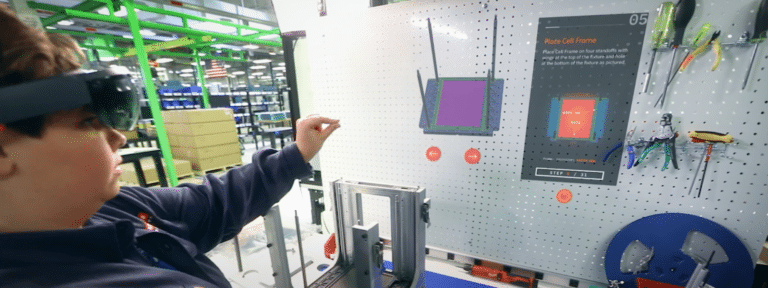
Imagine: It’s your first day as a service technician. You’re standing in front of a broken machine in urgent need of repair. Your only tool is a cumbersome, outdated paper manual that’s clearly passed through the hands of dozens of employees before you. You thumb through the pages only to find the instructions you need are missing, evidently torn out. What do you do? It’s an all too familiar scenario for organizations dealing with the growing industrial skills gap. The problem is especially acute in Manufacturing due to an aging expert workforce, rising complexity, outdated training methods, and continued reliance on decades-old machines in many of today’s factories. As competition and globalization intensify, the million-dollar question is: How do manufacturers recruit, train, and empower the next generation of skilled workers when the skills they need are rapidly changing? Best-in-class manufacturers have turned to Augmented Reality (AR) to develop and future-proof the skilled workforce. In the following use cases, real companies use AR to facilitate skills development while alleviating the impact of the industrial skills gap on their operations today. BAE SYSTEMS Sector: Aerospace and Defense Application: WORK INSTRUCTIONS + ONBOARDING British multinational defense, aerospace, and security company BAE Systems produces […]
7 min read
XR Content Creation: Enterprises Weigh in on the Challenges
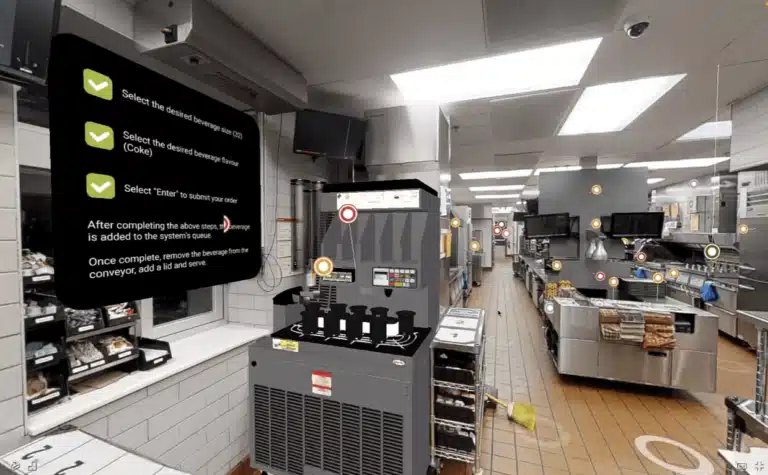
The first step to using AR/VR/MR (XR) in your business is 3D content creation. It’s also one of the biggest pain points, particularly the time and cost of capturing real-world environments and objects for immersive experiences. This was the subject of a recent webinar featuring Doug Stephen of TeamworkAR, Kevin Jordan of Matterport, and Eric Abbruzzese of ABI Research. Here are three takeaways from their discussion: ONE There is a clear need to simplify 3D content creation for enterprise XR applications. As viewers were joining the webinar and settling in, a poll was launched to determine the biggest barrier to scaling extended reality (XR) in enterprise. Above is a live screenshot as the results were still coming in, with “Content Design/Expertise” emerging as the clear leader followed by “Time to Value.” The responses paint a picture: Organizations in every vertical have a need for fast and affordable 3D content creation, in particular the development of high-quality digital twins and other interactive 3D models to populate XR applications. Driving this need are increasing digitization efforts in response to remote/hybrid work, highly sophisticated machines, and a tight labor market. 3D content development is becoming a key business capability, an essential skill set […]
3 min read

50+ Enterprise Metaverse Statistics You Need to Know for 2022/2023
Employees 52% of employees are open to meetings in the metaverse, while 47% are “okay” with representing themselves as avatars in these virtual meetings. (Microsoft Work Trend Index) One quarter of employees have already experimented with extended reality. A further 44% are interested in trying it. (CCS Insight) Lenovo found that 44% of employees are prepared to work in the metaverse, compared to 20% unwilling to work with the technology. Only 42% of employees are “very familiar” with the metaverse. 57% are interested in experimenting with immersive work. (ExpressVPN) Some of employees’ biggest fears when it comes to the metaverse are real-time location surveillance (51%), biometrics or facial recognition (40%), and time tracking (47%). (ExpressVPN) Generational Differences 51% of Gen Z and 48% of Millennial workers are interested in using the metaverse for work, compared to 37% of Gen Xers and just 27% of Boomers. (Microsoft Work Trend Index) 92% of Gen Z want to use AR for shopping. 60% said that AR experiences feel more personal and over half would be more likely to pay attention to an ad that uses AR. (Snap) 27% of Gen Zers say they would be “very comfortable” using digital avatars for virtual meetings […]
6 min read
Augmented Enterprise Newsletter
Get bi-monthly insights on AI, XR, digital twins, and related emerging enterprise technology delivered to your inbox.