
By Technology
When AR and AI Come Together for Your Business
70% of companies identify knowledge loss as a critical issue. 80% of the global workforce doesn’t sit behind a desk. 85.2 million worldwide worker shortage by 2030. These might seem like disparate facts but they are, in fact, all related and, together, contributing to a kind of global reckoning in the industrial world. The harsh reality is that organizations are losing people and, in turn, losing years of wisdom, expertise, talent, skills, workflows and systems. They’re losing knowledge as experienced workers retire and struggling to upskill the next generation of workers fast enough. Now, add to this the fact that a significant majority of the workforce is mobile and increasingly reliant on technology for the content, guidance, people and smart data they need to work efficiently and safely in industries impacted by factors like the growing skills gab and, most recently, a global pandemic. These workers need easy access to knowledge on the go. But what if there were a comprehensive tech stack that could help companies capture, preserve, organize and transfer knowledge across global, multilingual workforces while also improving collaboration, increasing efficiency, boosting safety, and reducing costs? Enter: Augmented Reality (AR) and Artificial Intelligence (AI). You may think you know the benefits […]
2 min read
Accelerating XR at Apple & Facebook: What it Means for Enterprise
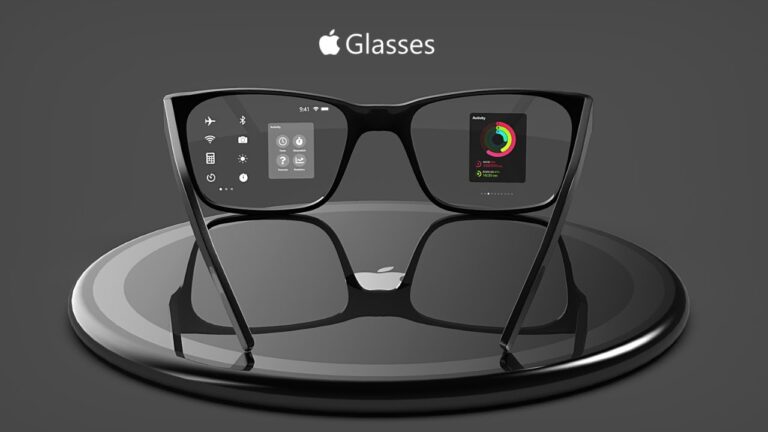
We don’t make it a habit of closely following consumer XR news, but it’s undeniable that the pandemic has accelerated AR/VR awareness among consumers, in particular the use of Oculus VR headsets and (mobile) AR shopping apps. So, what does growing consumer comfort with extended realities mean for enterprise? In 2019, I wrote a blog post titled “When is the Time to Talk About Consumer-facing AR Apps in Enterprise?” Now is the time to revisit this topic: Not only has Covid-19 forever reshaped how we work but competition has been heating up among the big tech players to develop the first pair of successful consumer-grade smart glasses. Apple leaks and news out of Facebook Reality Labs are a daily occurrence, and Microsoft recently confirmed it’s developing a consumer version of the HoloLens. So, let’s explore what the arrival of mainstream AR glasses and increasing commercial use of VR will mean for enterprise, from heavy industry to office work and everything in between. FIRST, THE RUMORS While it’s impossible to know exactly what’s going on inside Apple, there are strong indicators that augmented reality is important to the company, including CEO Tim Cook’s own words to the effect, recent acquisitions, and […]
6 min read
The most successful exoskeleton case study yet?
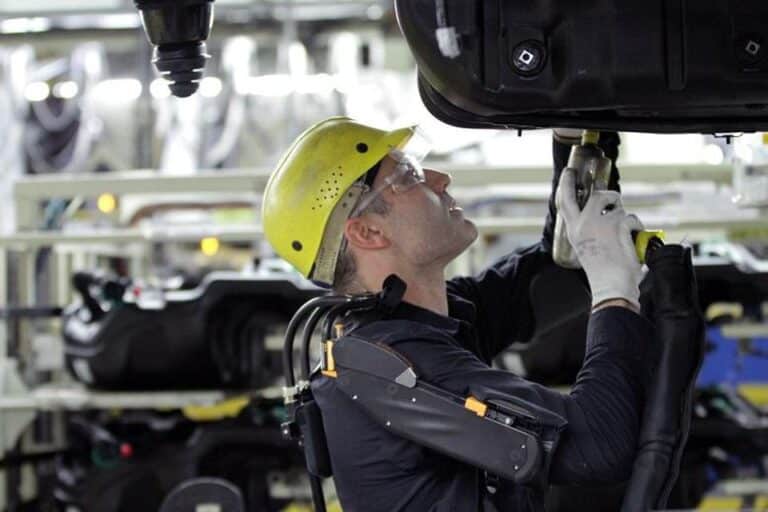
With 500 shoulder exoskeletons across 6 North American vehicle assembly plants, Toyota is perhaps the most successful use case of industrial exoskeletons to date. How has Toyota succeeded where others have yet to do so? In this video from EWTS 2020, Toyota’s Marisol Barrero describes how she and her team were able to implement exoskeletons as PPE. The cherry on top? Toyota is also using wearable sensors and virtual reality (VR) to enhance safety. Image source: Levitate
1 min read
U Can’t Touch This: VR Haptics
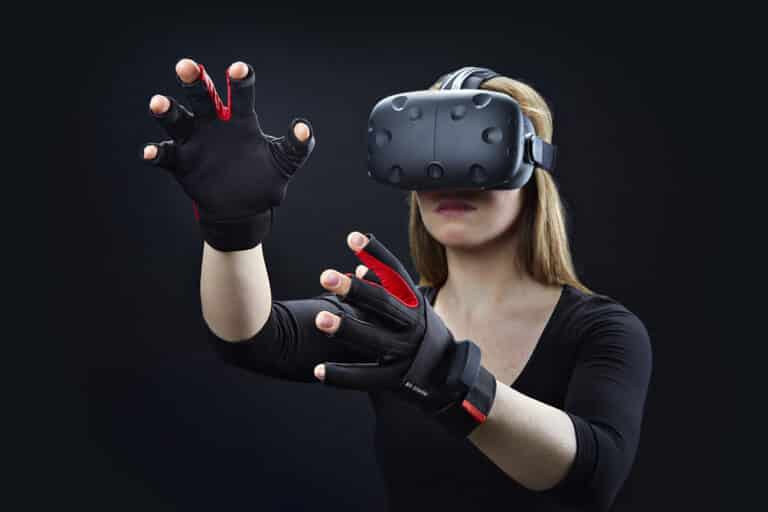
Immersive technologies are proving great at reducing the amount of hands-on training required to operate lift equipment or fly a plane, but can someone become certified in a trade by training in VR alone? JLG has a very realistic VR simulation that even incorporates real controls, but the industry standard requires hands-on training. If VR were to supplant traditional training, it would have to be as close to the real thing as possible. There aren’t any standards, however, for high-fidelity VR or a grading system for VR training sims. How do we get to that point? No Hard Feelings Currently in VR, you can tour a building before it’s built, test drive a car, and practice assembling a jet engine from scratch. You can’t, however, run your hand along a velvet sofa, judge the comfort of a vehicle’s interior, or feel the parts of a machine correctly locking into place. Touch is incredibly important to how we interact with and understand the world. Of all our senses, it’s probably the most overlooked and least understood. How does touch work? Specialized receptors all over our skin (there are 3,000 just in each fingertip) sense things like temperature, pain, pressure, texture, and vibration. That information is […]
7 min read
Exoskeletons Get Real: The Ultimate Wearable Technology?
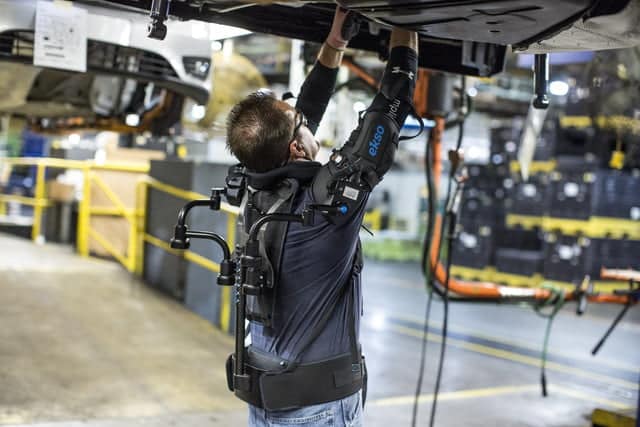
Exoskeletons are nothing new and far from science fiction; in fact, researchers began developing exoskeletons for military use as early as the 1960s. For the last decade, engineers have been working on exoskeletons designed to support and even augment physical activity for military, medical and industrial purposes. Over time, these devices have become less bulky and expensive (from over $100k to under $10k in many cases) as well as more specialized and powerful. Today, real companies are transforming workplace productivity and safety by introducing even just a few exoskeletons on the warehouse or factory floor. According to ABI Research, more than 7,000 exoskeletons were sold in 2018, the same year that Ford made headlines for the largest order of exoskeleton units to date. Last year, Toyota became the first company to make exoskeletons mandatory PPE for certain tasks. (Watch this video of Toyota’s Marisol Barrero from EWTS 2019.) While it may seem the most successful rollouts are in automotive manufacturing; aviation, aerospace and other manufacturers as well as construction and engineering firms, warehouses and more are actively testing the technology, as well. Exoskeletons find their sweet spot Combining the power of robots with the intelligence and adaptability of humans sounds great, but […]
9 min read
Accessing XR in the Workplace of the Future
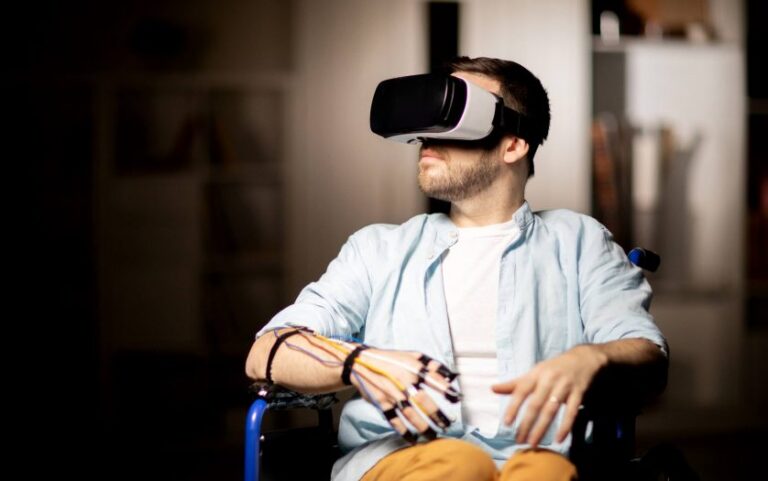
If you’re unfamiliar with Augmented Reality (AR) and Virtual Reality (VR) in the enterprise, here’s a crash course: Companies such as Boeing, Ford and Walmart are adopting immersive technologies like AR glasses and VR headsets to improve efficiency, productivity, and safety via a number of applications like training and remote support. Immersive technologies (AR/VR) could improve lives and contribute to the GDP by enabling people with disabilities to take on careers that have so far been closed off to them. Unfortunately, enterprise AR and VR tech isn’t currently designed with disabled users in mind. This is an untapped opportunity for XR companies and employers alike. The unemployment rate for people with disabilities is significantly higher than for able-bodied people. Employers are required to provide reasonable modifications to the work environment to enable disabled persons to do their jobs. That might mean a wheelchair ramp or adaptive hardware for computer use. But, so far, it hasn’t included immersive devices. While the hype around AR and VR focuses on democratizing knowledge and access to new worlds, the technology hasn’t extended to the disabled community. Let’s look at VR in particular: It often takes coordinated body movements to navigate and interact in the virtual environment. User interfaces that […]
4 min read
Bayer Accelerates Crop Science Data Collection with Smart Glasses and Voice
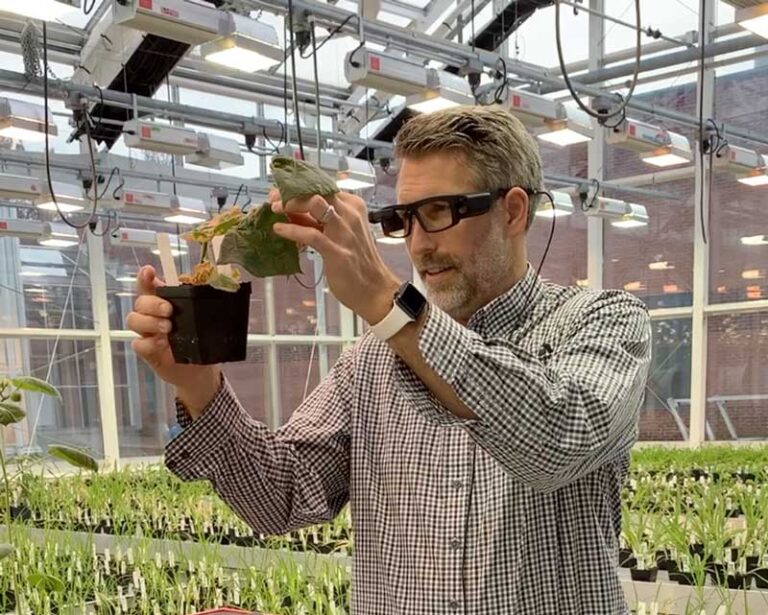
Interview with Michael Calvillo and Carrie Roy I recently had the privilege of interviewing Michael Calvillo and Carrie Roy, who are spearheading the use of voice and smart glasses to collect data at Bayer. Check out their answers below: To begin, could you provide a little background on yourselves and what you do at Bayer? Carrie: I’ve been consulting at Bayer for two years. My background is a bit odd. I was planning on going into Academia, so I have a PhD in Ethnography and ended up doing a two-year postdoc in Digital Humanities, like computational approaches to analyzing screenplays, literature, poetry, images, music and that type of stuff. Following that, I ended up working with data-inspired art – I’m really interested in how we engage with data and information – and then started working for a large consulting firm doing some work on large, high-profile AI projects. After moving to St. Louis with my family, I was interested in getting back into agriculture – I actually grew up on a cattle ranch in North Dakota and a lot of my extended family farms – and I’d heard good things about Bayer. During my post-doc I partnered with a lab working […]
12 min read

Look Here: Eye Tracking in Second-gen VR
The latest (high-end) enterprise VR headsets have something in common: The integration of eye tracking. It seems eye tracking is becoming the standard for second-generation virtual reality headsets, and there are a number of compelling applications that should be on your radar. Gaze Matters Eye tracking isn’t new; the technology has long been used for research, including marketing and medical research. With recent advances, however, the data is becoming easy and fast to collect and, as a result, it’s becoming easier and faster to train algorithmic models based upon eye tracking data. Eye or gaze tracking measures the direction of your gaze. Combined with head tracking and potentially additional biometric sensors (ex. EEG), you can learn all kinds of things about the user. In VR, eye tracking has user interface and performance implications, which make the experience more immersive. For one, it can be used as an input method, a way of interacting with content in the virtual world. Gaze is a natural user interface, allowing you to simply look and grab a virtual object and enhancing the social interaction between users in multiuser VR simulations. Input aside, eye tracking improves headset performance, making it possible to reduce GPU load […]
9 min read
Get Creative for Easy AR Implementation: Interview with Six15’s CEO Rich Ryan
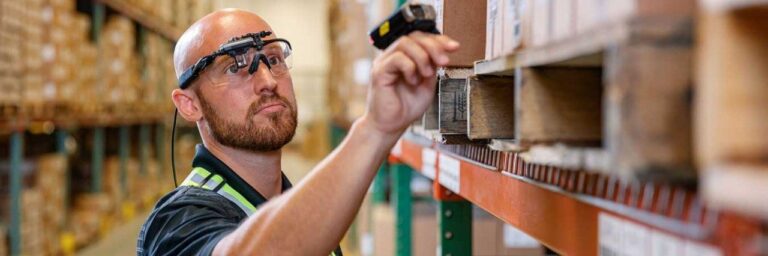
The HD4000 is not your average pair of smart glasses. Learn about the device, the brainchild of Six15 and Zebra Technologies by reading our interview with Six15’s CEO Rich Ryan. Emily: How did the collaboration with Zebra Technologies come about? Rich: Four years ago, we started working with Zebra Technologies as they were investigating how to enter the Enterprise Augmented Reality market given the growing demand from customers. When they were looking for potential partners, they were attracted to our strengths in terms of building rugged, reliable head-worn displays in addition to our innovative optics. Those leading optics were developed over many years for our defense customers. Zebra saw the development of our product, the ST1™ head-mounted display, and chose to partner with us to advance the product to meet the demanding requirements of their customer base. Emily: Zebra’s head-mounted display, built off Six15’s ST1™ platform, is called the HD4000. What are the unique or key features of the HD4000 that make it enterprise-ready, and is it mainly for warehousing applications? Rich: The Zebra HD4000 is a rugged, monocular head-mounted display that seamlessly integrates with Zebra’s mobile computers. By tethering to a host device via USB, it leverages both […]
8 min read
Turn Down the Noise: 3D Audio
I was recently gifted a pair of Apple AirPods. I’ve had noise cancelling headphones before, but the AirPods Pro offer something new: Active noise cancelling and a transparency mode that uses built-in microphones to allow outside sounds in when I want them. I’m not an audiophile and this isn’t an Apple ad, but I am very sensitive to sound at work. I’m at my most productive with music in my ears, but as soon as a coworker answers a phone call, my concentration breaks. (Hell is other people, am I right?) Source: Apple The AirPods got me thinking about noise in the workplace and the role of sound in immersive experiences. As extended reality headsets improve and new tools make it easier to create 3D content, the absence of our other senses in XR is becoming more noticeable. Big, bad noise Most people today use headphones for attention management. According to Bitkom, nearly 50% of people wear headphones to mute their surroundings while 20% do so to focus on work. Millennials are especially concerned about rising decibels. The government caps safe noise levels around 90 decibels, but Cornell University reports that office workers are most comfortable between 48 and 52 […]
5 min read

Building the Future of Exoskeletons: Meet Dr. William G. Billotte
He’s working with BMW, Boeing and others to introduce standards and raising the bar in the exoskeleton market: Meet Dr. William G. Billotte, Physical Scientist at the National Institute of Standards and Technology (NIST) and Vice Chairman of the ASTM F48 Exoskeleton and Exosuit committee. I got to interview Dr. Billotte on the importance of standards and fundamental work of NIST. Read our conversation: (Full bio at the end) Emily: To begin, could you provide a little background on yourself and NIST? When did you first start working on exoskeleton tech? W: My background is I’m an engineer and a biologist with a bachelors and masters degree in engineering and a PhD in biology, and I’ve been working in the biology/engineering area for probably 17 or so years, providing scientific and technical guidance to different federal agencies, first responders and other organizations. I’ve worked in a number of different areas: biological detection, first responder equipment, critical infrastructure protection, etc. I’ve been in the exoskeleton area since around 2014. I work for a federal organization, the National Institute of Standards and Technology (NIST), part of the Department of Commerce (see here for some history). I’ve been here since 2009 as a […]
10 min read

Workplace implantables–Yes, we’re going there.
Are workplace implantables a future reality? Implantables are sometimes mentioned as a category of wearable technology, but is a future in which technology becomes more integrated with our biology, in which we voluntarily have technology embedded beneath our skin at work, possible? Some think widespread human microchipping is inevitable; others believe it would mark the end of personal freedom, and still others refer to it as “the eugenics of our time.” If it does happen, Europe will already be ahead of the game. Today, more than 4,000 people in Sweden have consented to having microchips injected under their skin, and millions more are expected to follow suit as the country trends towards going cashless. In addition to enabling Swedes to pay for things with the swipe of a hand, the technology can be used to ride the train (Sweden’s national railways are entirely biochip-friendly), unlock doors, monitor one’s health, and even enter many Nordic Wellness gyms. At the forefront of the microchip movement are two European firms: BioTeq in the United Kingdom and the Swedish Biohax International founded in 2013. Both firms make a pretty basic chip that’s inserted into the flesh between the thumb and forefinger. The chips don’t […]
7 min read
Augmented Enterprise Newsletter
Get bi-monthly insights on AI, XR, digital twins, and related emerging enterprise technology delivered to your inbox.