
Editorial

Preventing Casualties of XR in Enterprise
A New York Times article published on February 6th told the story of Doug Schifter, a New York City yellow cab driver who had taken his own life in front of City Hall. In a Facebook post, Schifter – who was in his early 60s – condemned city and state politicians and ride-sharing apps like Uber that had “de-professionalized” his career of over 30 years and made it impossible for him to earn a living. The Times article described Doug as a “casualty” of the gig economy. I know this is a rather depressing way to begin a blog post, but I believe that in Schifter’s death there is a lesson that applies to the global workforce, a force that is quickly changing due to digital disruption. And as enthusiasts, providers, facilitators and users of emerging tech in enterprise, it is important for us to heed that lesson. Uber and its rivals have been incredibly disruptive to the taxi industries in cities around the world. But the rideshare service, a concept realized with algorithms and a mobile app, didn’t eliminate jobs so much as influence supply and demand, increasing supply while offering a convenient solution to the same needs […]
5 min read

Where Are the Simple but Effective Wearables?
Remote collaboration via smart glasses, Virtual Reality training, design visualization with HoloLens…These are incredible applications of wearable technologies in enterprise today. While a VR headset is definitely more exciting than a connected wristband, an unassuming wrist-worn device equipped with the right sensors could have tremendous value in the workplace. But where are such simple wearables? No stranger to employee backlash, Amazon is currently taking heat for a pair of patents awarded to the company. The patents – for wristbands that use ultrasonic pulses and haptic feedback to track and guide a worker’s hands in relation to inventory bins in a warehouse – have raised concerns over employee privacy and workplace surveillance. This is not surprising to anyone who follows the enterprise wearable tech space—privacy has been one of the major challenges holding back widespread adoption of wearables in the workplace. Nevertheless, enterprises are managing to work around the issue today by being transparent, allowing opt-in, and taking the security of workers’ personal data seriously. To those criticizing the employee-tracking wearables as invasive, Amazon insists the technology would be used to track inventory and not individuals. But can you really track one and not the other using a wearable? Yes, the […]
4 min read
Wearable Technologies 2017: Year in Review, from Glass Enterprise Edition to ARKit
2017 brought us the public reveal of Google Glass Enterprise Edition and a jumpstart to consumer AR adoption in the form of Apple’s ARKit and Google’s ARCore. Augmented and Virtual Reality made further headway in enterprise, especially for design collaboration, assembly instructions, and training. Worker safety wearables cropped up on job sites while exoskeletons pulled their weight in automotive plants. And smartwatches proved to be a useful tool for employee productivity in several workplaces including restaurants and airports. Here’s a recap of the best use cases and biggest developments from this past year in wearable technology. A number of enterprises made headlines for their use of wearables in 2017 The most covered use case – and among the most mature use cases out there – was AGCO’s use of Google Glass Enterprise Edition. At the manufacturer’s Jackson, MN factory, employees have been using Glass Enterprise Edition with Proceedix software in assembly and quality assurance for some time now. AGCO was actually one of the companies that worked with Google behind the scenes to improve upon the tech giant’s original smart glasses device. (Watch Peggy Gulick of AGCO speaking at EWTS Fall 2017 (Video) and read our interview with her here) […]
6 min read
Enterprise Wearables: What to Consider in Choosing Hardware
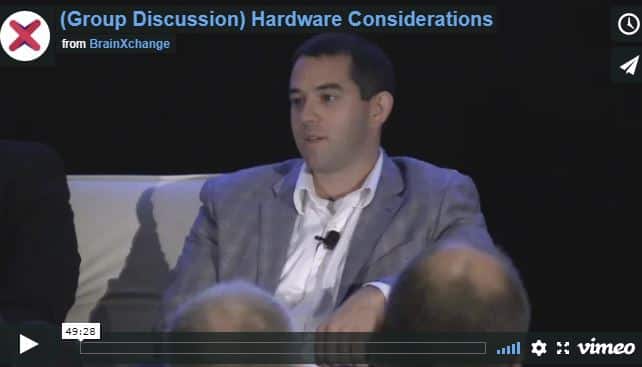
Watch Ramon Llamas, Research Manager at IDC, take leaders at General Dynamics Electric Boat, Gulfstream Aerospace, Duke Energy, Rogers-O’Brien Construction, and Atheer through the hardware considerations of wearables in enterprise. Whether used in designing submarines or to provide power and gas to millions of people, an enterprise wearable device has to suit both the environment in which it is used and the user or wearer in terms of ergonomics and performance. Key Learnings and Takeaways: Hardware considerations are first and foremost in beginning one’s wearable journey in the enterprise, and often the customer is internal—a group of workers. Ramon does a great job of eliciting key words of advice from the panelists, like this takeaway from Ken Fast of General Dynamics Electric Boat: Things can take a long time to implement in a large company, so maintain a kind of childlike excitement about the technology. Ken develops solutions to support those who design and build nuclear submarines at General Dynamics. He points out that employees who only need a few minutes of textual instruction before doing, say, half an hour of work don’t really need a heads-up display—a tablet is fine. But for employees requiring constant guidance, Augmented Reality […]
4 min read

How Your Business Can Prepare for an Augmented Reality Future
Whether you believe Apple’s latest announcements mark the arrival of mainstream Augmented Reality or still think mass use of AR is years away; smart (AR) glasses are the future. The question is how long we will hold onto our smartphones for (and yes, which device and/or platform will tip the technology in the consumer market’s favor.) Just as glasses are the ultimate form factor for workers in factories, out in the field, in the O.R., etc.; heads-up and hands-free is ideal for consumers. The biggest problem with our phones is that we carry them everywhere and are constantly looking down at them. AR will not only provide better contextual information to enrich our daily lives, but it will also revive an element of society that today can feel somewhat foreign compared to texting or email (especially to Millennials;) and that is face-to-face human interaction. (FaceTime doesn’t count.) So why aren’t people more eager to free their hands and gaze from a hand-held screen? Smartwatches seem to have broken into the mainstream or are at least accepted by consumers. What is it about putting on a pair of glasses? It’s not just aesthetics and privacy concerns. In enterprise, you identify a […]
7 min read

What Enterprise can Learn from the Red Sox Smartwatch “Scandal”
If you haven’t already heard, the Boston Red Sox were caught using an Apple Watch to steal opposing teams’ pitching signs during games. There’s no question that cheating is wrong. Rules are rules. But what this story highlights is just how disruptive wearable technology truly is. There is no industry that won’t feel the impact, that won’t be forced to somehow transform, innovate and ELIMINATE–eliminate old technology (when a wearable is the superior form factor for the task,) old systems (that don’t work in a heads-up display or on the small screen real estate of a smartwatch,) old processes and procedures (that wearables can optimize,) old job positions (some jobs are going to become obsolete while new ones are created or extended,) and last but not least old rules. This is a new era of enterprise mobility, removing shackles (for lack of a better metaphor) that we weren’t really aware of until we experienced truly hands-free and truly advanced – and sufficiently miniaturized – sensor technology. It’s not just that we need to update our mobile device management rules and strategies to account for that increased mobility, increased security risks, etc. We also need to update the rules to account […]
2 min read

What Can Industry Learn from Parks and Entertainment Use of Wearable Tech?
We know wearables, AR, and VR aren’t going away. These technologies will fundamentally change how we live and work, but the full extent to which they will do so is unknown—the applications could be limitless. Most companies are still trying to figure out what emerging technologies will mean for their business. At this point, there isn’t widespread use in any one industry so enterprises have to 1) think outside the box, and 2) look outside the box. They need to think about how to apply brand new technologies with brand new capabilities to existing processes; and also look to other industries and verticals for examples from which to distill applications, lessons and best practices. Take AGCO: In addition to employing Google Glass on the assembly line, the agricultural equipment manufacturer has incorporated Glass into its factory tours. This isn’t your typical remote guidance use case; it’s an application that arguably borrows from the parks and entertainment industry. What follows is a lesson in looking outside the box: Eight use cases of wearable technology in amusement and entertainment that have implications for industrial enterprises. Theatre in Paris In December 2015, Theatre in Paris, an English-speaking box office in Paris, launched an […]
7 min read

The Inevitable Rise of Google Glass 2.0
The use cases mentioned in Wired’s breaking story about Google Glass 2.0 are supreme examples of Google Glass’ success in the workplace. AGCO, Boeing, DHL and GE are certainly major companies validating the benefits of Glass to enterprise. Their stories have been shared here on EnterpriseWear as well as at every Enterprise Wearable Technology Summit. (See Wearables in Manufacturing: Interview with AGCO’s Peggy Gulick ; Wearables in Industry: Interview with GE’s Sam Murley ; and Wearables in Logistics: Now or Later?) But there have been numerous use cases by big and small companies alike since Glass made its ill-fated consumer debut in 2012. Not all those early explorations were developed further; some of the first experiments were simply small, short pilots that were subsequently dropped because the tech wasn’t ready or because the company may not have had the resources, connections or patience of a Boeing or GE. But it was those cases that taught Google a big lesson, encouraging the company to direct its attention to the enterprise and get to work on what would ultimately become Google Glass Enterprise Edition. While companies like GE and Boeing have been clandestinely using Google Glass EE for a while now, it’s […]
4 min read
Enterprise Wearables: Deployment Best Practices
How do you ensure a successful pilot or smooth rollout of wearable technology in your business? First thing, did you choose a viable use case? Before you go ahead buying devices and signing contracts, take a step back: Did you identify the business problem or need? Does the wearable solution match or address that need? Wearable technologies like smart glasses aren’t right for every area, worker, process or task in your business. Not every use case requires the level of technology of AR or VR (as exciting as those devices are.) Go after the lower hanging fruit—obvious or very practical applications (ex. replacing simple paper-based work instructions with heads-up ones,) something that doesn’t have a great barrier to entry. Be realistic. If you’re a small company or innovation team with limited funds or resources, don’t go after the more complex Augmented Reality use cases. You will have the chance to disrupt your business with AR as the market matures, but start by taking advantage of the basic features of smart glasses (like the hands-free form factor, front-facing camera) to make small but significant improvements and prove the value to others. A use case in which the technology is self-contained is […]
5 min read

Applications and Hardware: 18 Guiding Questions for Your Business
Trying to get started on your enterprise wearables journey? How do you determine a good use case or figure out which technology is right for your work environment and workforce? Here are some helpful guiding questions and key considerations for identifying potential business cases: Are your standard work procedures still paper-based? Where in your operations do workers rely on paper instructions, manuals, lists, schematics or forms? Is the use of paper-based tools a source of inefficiency? Is it feasible to digitize this information? Would a wearable mode of delivery be more effective? Do workers use smartphones, tablets or other hand-held devices to carry out processes? Is it a problem that these devices are fragile and not hands-free in your work environment or in certain scenarios? Do they cause accidents? Do workers always carry these devices with them? Do they break often? Can you deliver the same information hands-free? Which processes require delivering work instructions to employees on the line, in the field, or with a customer? Where is that information located? Could you make it more readily available (bring it closer) to the worker? How do workers access or receive task-critical information? Is this method ergonomically in line with the […]
5 min read
EWTS Fall 2017 Trailer
The Enterprise Wearable Technology Summit (EWTS) is the leading event focused on the use of wearable technology for industrial enterprise applications.
1 min read

3 Things You Should do When Preparing Your Organization for Enterprise Wearables
Last week, Chris Croteau, General Manager of Head-worn Devices at Intel, and Jay Kim, Chief Strategy Officer of Upskill (formerly APX Labs), shared a lot of juicy information in the webinar “What’s Next: Preparing Your Organization for Enterprise Wearables.” Here are three takeaways: Know where you’re coming from to get to where you’re going Chris and Jay kicked off the webinar by reflecting upon Industry 3.0, the first phase of digitizing the industrial base in which we began the transition from manual-based records to digital ones. Data was incorporated into systems, which allowed for tracking and analytics but also created “islands of information” and “disparate systems”—challenges that wearables and AR interfaces address.To understand the promise and opportunities for wearable technology in your business, it’s necessary to understand the challenges that came out of the revolution that preceded the one we are witnessing today. Wearables are incorporating human beings – the industrial workforce – into this next wave, transforming how workers interact with information from those systems of record in real time via a medium or form factor that doesn’t cause disruptions. Start with structured information within your current systems of record Your current systems of record (ERPs like MES, WMS, […]
3 min read
Augmented Enterprise Newsletter
Get bi-monthly insights on AI, XR, digital twins, and related emerging enterprise technology delivered to your inbox.